
Ask ten instructors what makes a new driver slow and you'll get one answer more than any other. Not brake points. Not the line. Their eyes are too close to the car.
It's the cheapest lap time in motorsport. It costs nothing, it takes no parts, and almost nobody does it properly on day one.
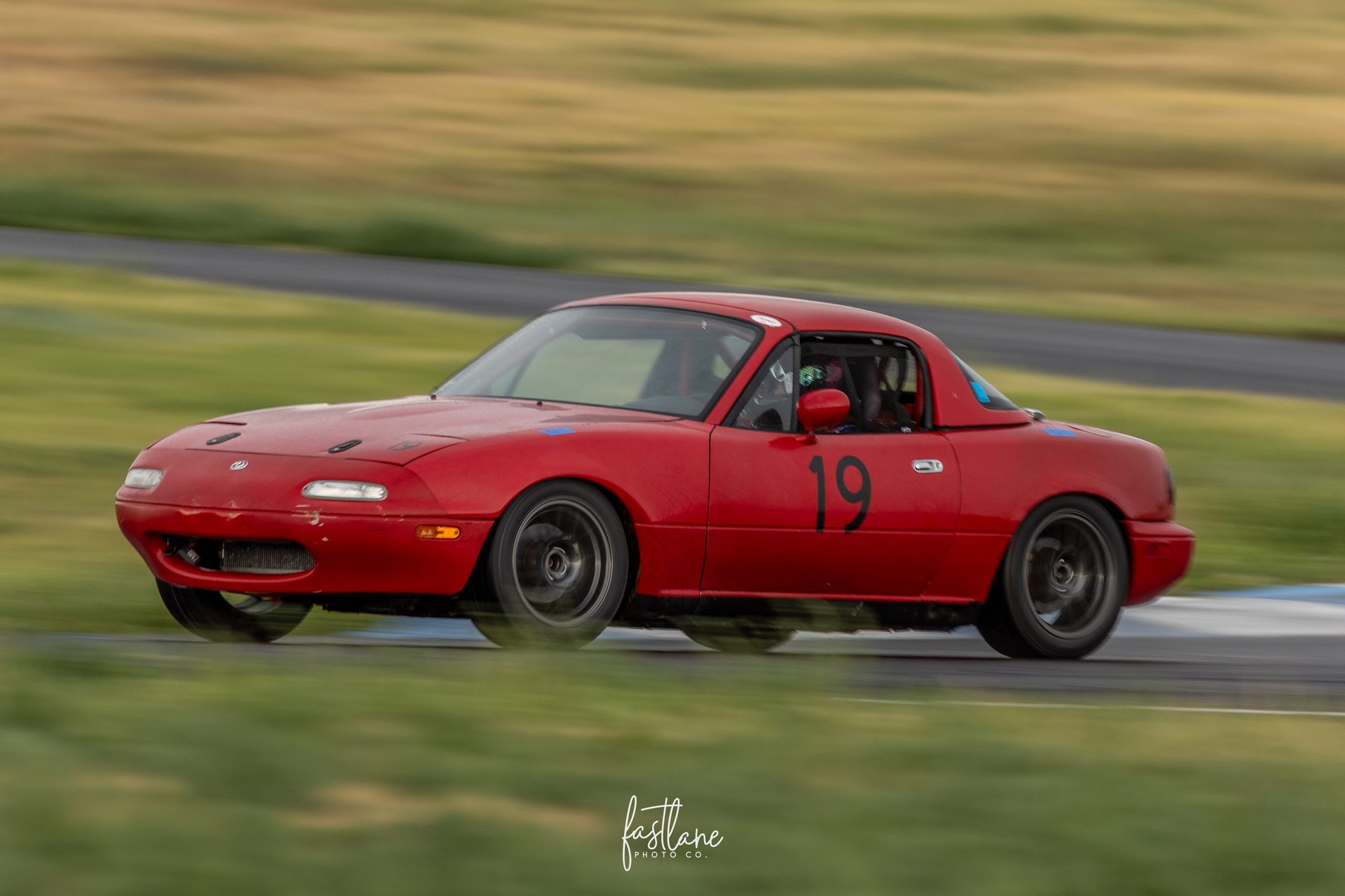 Our #19 at High Plains Raceway. At this speed the driver's eyes are already at the next corner, not on the curb under the wheels.
Your eyes are steering the car
This isn't a coaching metaphor. It's measurable.
A 2001 study in Current Biology put eye and head trackers on a racing driver during high-speed practice laps. Through the corners he spent most of his time looking close to — but not exactly at — the tangent point on the inside edge of each bend. The striking part was the timing. His head direction lined up almost perfectly with how fast the car was rotating about one second later.
His head was writing a check the car cashed a second down the road.
A more recent eye-tracking study of a professional driver found the same thing and added a detail. Head movement did nearly all the work, tracking the car's rotation far more tightly than eye movement did, with the car following about two-thirds of a second behind. That driver also made one deliberate look away from the apex toward the exit before he got there — in the same spot lap after lap.
There's a plain physical reason this matters. The part of your eye that sees real detail, the fovea, covers only about two degrees of your visual field — roughly a couple of thumbnails at arm's length. Everything else is peripheral: fast, great at motion, bad at detail.
You get one small spotlight of sharp vision. Where you point it decides what you know.
Point that spotlight at the pavement ahead of your bumper and you've spent it on information you can't use. That piece of road is already decided.
The one-stage-ahead rule
Every coaching system lands in the same place. Look one stage further along the track than the stage you're driving.
Driver61 puts it exactly that way: braking and turning, you look at the apex; at the apex, you look at the exit. Ross Bentley teaches the same idea as references that are "two ahead."
Run it through one corner:
- Down the straight. Find your brake marker early, ten car lengths out or more, then let it slide into your peripheral vision. No need to stare at a cone you've already located.
- On the brakes. Eyes to the apex. Not the turn-in point — the apex. Turn-in arrives whether you watch it or not.
- At turn-in. Eyes stay on the apex while your hands and feet do the blending. If you're trail braking, this is where vision earns the most.
- Just before the apex. Look to the exit, and past it, to the edge of road you plan to use. That's what tells you how early you can unwind the wheel.
- At the exit. Eyes down the next straight to the following brake marker. Mirrors get a glance here, not mid-corner.
Bentley's version of the scan is worth stealing whole: a quick glance far ahead to set the target, a slightly longer focus on the key reference, and constant peripheral monitoring of everything closer in. Your eyes should never park anywhere for long.
One honest caution, because this advice gets flattened into "just look far ahead." Driver61 points out that if you only look a long way up the road, you lose the near information you need to place the car. It's a scan, not a stare. You're living about a second and a half to two seconds ahead of the car — not ten.
Traffic changes the job
The moment there's another car involved, vision stops being a lap-time tool and becomes a safety tool.
New drivers lock onto the bumper ahead and react to brake lights. That's half a second too late, every time. Look through the car in front — three or four cars up the road if you can see that far. You'll spot the check-up, the wiggle, and the dust before any of it reaches you.
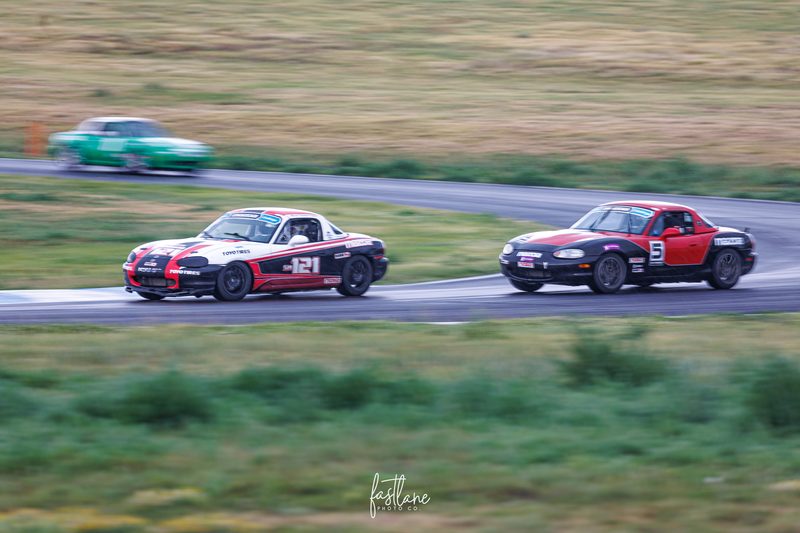 Nose-to-tail on a damp High Plains Raceway. In traffic, the driver who is looking furthest up the road has the most time to make decisions.
Mirrors are the other half. Check them on the straights and at corner exit — never mid-corner. In an HPDE, that habit is what lets you give a clean, early point-by instead of a panicked one.
Four vision mistakes worth killing
Looking too close. The default setting for every human who learned to drive on public roads. Fixing it feels wrong at first, like you've stopped watching the road. Do it anyway.
Target fixation. You stare at the thing that scares you — the wall, the cone, the car spinning ahead — and your hands quietly steer you toward it. That's the head-steering research working against you. Look at the gap, not the obstacle.
Vision shrinking as pace rises. This one catches experienced drivers. Go faster and your field of view narrows on instinct. Driver61's material cites Nigel Mansell describing exactly that in Formula One, and having to consciously push his vision back out over several sessions. If you get a new car or a big tire upgrade, expect it and re-do the work.
Staring at one reference. Apex-hypnosis is real. You nail the apex and blow the exit because you never looked up. The apex is a waypoint, not a destination. Most of the errors in our turn 1 breakdown start as vision errors.
Four drills that actually work
You can't fix this by reading about it. You fix it with reps.
- The 80 percent session. Run one session deliberately slow, and spend the entire thing on nothing but eyes. Force them to the apex on the brakes and the exit at turn-in. Pace comes back on its own; the habit sticks.
- Narrate out loud. Say your target as you go: "apex... exit... brake board." Saying it stops you drifting back to the hood. You'll feel ridiculous. It works, and nobody can hear you.
- Walk it, then watch it. A track walk gets your eyes to driver height and shows you what's actually visible from each braking point. Our guide to walking a track properly covers what to look for.
- Audit your own video. Point a camera where it sees the road and the wheel, then look for the moment your hands get busy. Busy hands are almost always late eyes. The method is in our GoPro review process.
The Colorado version of this
Our home track makes this brutal, in a useful way. High Plains Raceway is 2.55 miles, 15 turns, and over 300 feet of cumulative elevation change per lap. Crests genuinely hide apexes out there. The pavement ahead of your hood tells you nothing, and drivers who won't lift their eyes fight the place all day — the whole theme of our HPR track guide.
Pueblo Motorsports Park teaches the opposite lesson. It's flatter and more open, so there's less scenery to lean on. You end up building references out of curbing edges, seams, and marker boards instead.
If you'd rather work on this with a coach in the right seat than guess at it alone, that's what our arrive and drive weekends are built around. Either way, the drill is free and you can start it at your next event.
Lift your eyes. The car follows.
Sources: Driver61 — Improving Your Vision on Track, Speed Secrets — Where should I be looking when driving on a race track?, Blayze — Vision on the Race Track (written by Daytona 24-hour winner Dion von Moltke), Land & Tatler, "Steering with the head: the visual strategy of a racing driver," Current Biology, 2001, The racer's gaze: visual strategy in high-speed sports expertise, Fovea centralis, High Plains Raceway. The two eye-tracking papers each studied a single professional driver, and the more recent one was run in a simulator — treat the figures as strong indications, not universal constants. Everything else here comes from coaching drivers in our own cars at HPR and Pueblo.
Do you believe?