
The rear steps out. You catch it, and then it snaps the other way. Now the windshield is full of grass, then the track, then the cars behind you.
You have about two seconds to make good decisions. Most people who spin at a track day don't get hurt by the spin. They get into trouble with what they do during it and right after. Here's the order of operations.
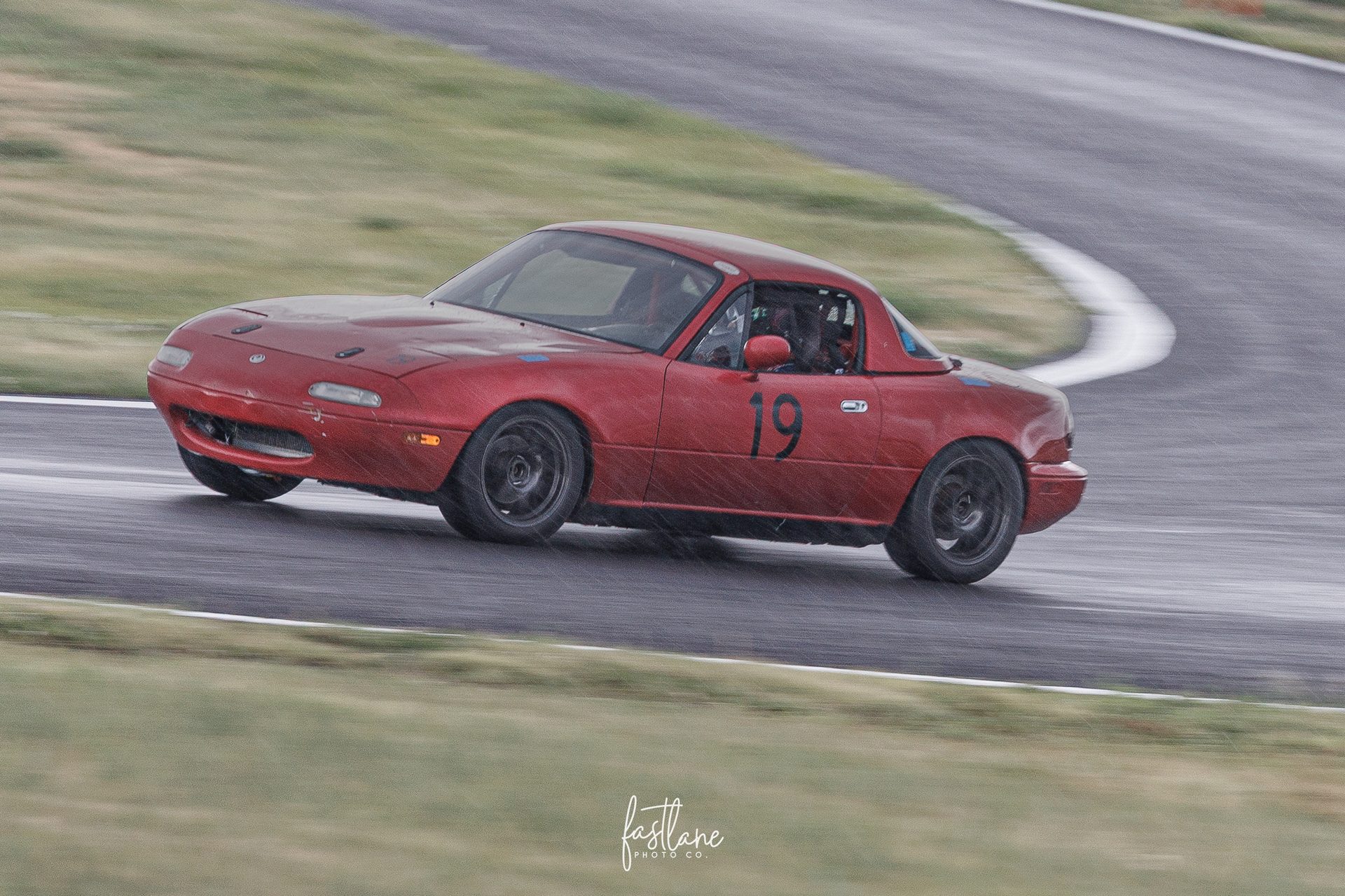 A wet corner at High Plains Raceway. Low grip like this is when "both feet in" earns its keep.
Step 1: Both feet in
The moment you know the car is going around, push the clutch in and stand on the brake. Both pedals, all the way.
- Clutch in keeps the engine from stalling. A running engine means you can drive away. A stalled one means you're a parked car on a live track.
- Brake hard stops the car as close to where the spin started as possible.
That second part is the real goal. Driving coach Ross Bentley puts it this way: you want the spinning car to stay in as small an area as possible. Most of all, you don't want it rolling backward across the track into the cars behind you.
Driving an automatic or a paddle-shift car? There's no clutch, so it's one foot. Bentley's version for those cars is simple: in a spin, stand on the brake pedal.
What about ABS? The phrase is older than ABS, and locked wheels hold a car in place better. Bentley still says maximum braking is usually better than none. Keep your eyes where you want the car to end up.
Step 2: Don't try to save it
Most spins start in the correction, not the mistake. You catch a slide with a big handful of lock. The rear grips again, and the car snaps the other way. We covered that snap in understeer vs. oversteer. Bigger, later corrections make it worse. Once the car is truly going around, stop fighting it and keep both feet in.
The same goes for dropping wheels off. SVRA's rule says it plainly: "If you go off course, stay off, do not try to save it." If two wheels go into the dirt, keep the wheel fairly straight. Ease off the throttle, scrub off most of your speed, then come back on gently. Yanking the car back onto the pavement at speed is how a two-wheels-off becomes a spin across the track.
Step 3: Stay in the car and look for the corner worker
Stay in the car with your belts on and your helmet on. Pocono's HPDE rules say to stay inside unless there's fire or smoke. They also say a car off track holds its position until it's signaled back on. A track car is much safer to be in than to stand next to.
Now find the nearest flag station. The corner worker has seen the whole thing and can see traffic you can't. NASA's rules say a driver who spins off the track "shall try to enlist the help of a Course Official to wave him/her back on safely." Wait for that wave.
Step 4: Rejoin only when it's clear
If you can't see a worker, SVRA's rule gives the standard. You rejoin only when there's a gap in traffic big enough that if you stall, oncoming cars can see you from a distance. Their summary is two words: "When in doubt, WAIT."
When you do go:
- Check your mirrors and look back up the track.
- Pull back on off the racing line, not across it.
- Drive gently. You may have grass, dirt, or gravel in the tires and brakes.
SVRA puts the responsibility for a safe re-entry on the car that went off. That's you.
Step 5: Go straight to the pits and tell them
Under NASA's HPDE rules, after a spin or off-track excursion, you "shall pull into the hot pits immediately." Officials check the car and talk to you. SCCA's 2026 Track Day Rules ask for the same thing. Four wheels off, or a "significant loss of control," and you self-report to the pit area. Drivers who don't can be black-flagged.
Coming in on your own makes it a safety check and some coaching. Waiting to get flagged in makes it a discipline talk. We break down that difference in what happens when you get black-flagged.
Expect a look for leaks and dirt in the wheels, and a question about what happened. Be honest. "I lifted mid-corner and the rear came around" gets you useful coaching.
Is one spin a big deal?
Usually not. NASA's HPDE rules use a ladder for violations like spins and offs. The first is a warning, the second ends your session, the third ends your day. In the advanced group, NASA counts "repeated spinning" as the offense, not a single one.
NASA also says spinning with a passenger aboard can cost you passenger privileges for the day. And if your spin turns into contact, it's a whole different process. Read what happens if you crash at a track day before your first event.
Running with NASA Rocky Mountain at High Plains Raceway or Pueblo? The drivers meeting covers how that event wants you to rejoin and report.
What I couldn't verify
Neither High Plains Raceway nor Pueblo Motorsports Park publishes a spin or rejoin procedure that I could find. The two-wheels-off advice is common instructor practice, not a written rule. Your event's rules and your instructor come first.
Sources: Speed Secrets / Ross Bentley: What does "in a spin, both feet in" mean?, NASA Club Codes & Regulations 2026.3, Sections 2.6.4.1, 6.4, and 6.7, SCCA Track Day Rules, Section 3.3, SVRA Red Flag and Spin/Off Procedures (January 2026), Pocono Raceway HPDE Track Day Rules, The Truth About Cars: Taking Yourself for a Spin (Jack Baruth, 2016). Checked November 2026. Rule quotes come from the published documents. Your series and event rules come first.
If you want somewhere to write down what happened after a session, spin or no spin, the free Race Day Ready Pack has a post-session debrief sheet and a setup tracker.
Do you believe?