
Watch a novice and a fast driver take the same corner. The novice turns in early, runs out of road on the exit, and lifts. The fast driver seems to turn in too late, then is back on the throttle while the novice is still fixing the mistake.
That gap is the racing line. Here's what it is, how it works, and how to start driving it.
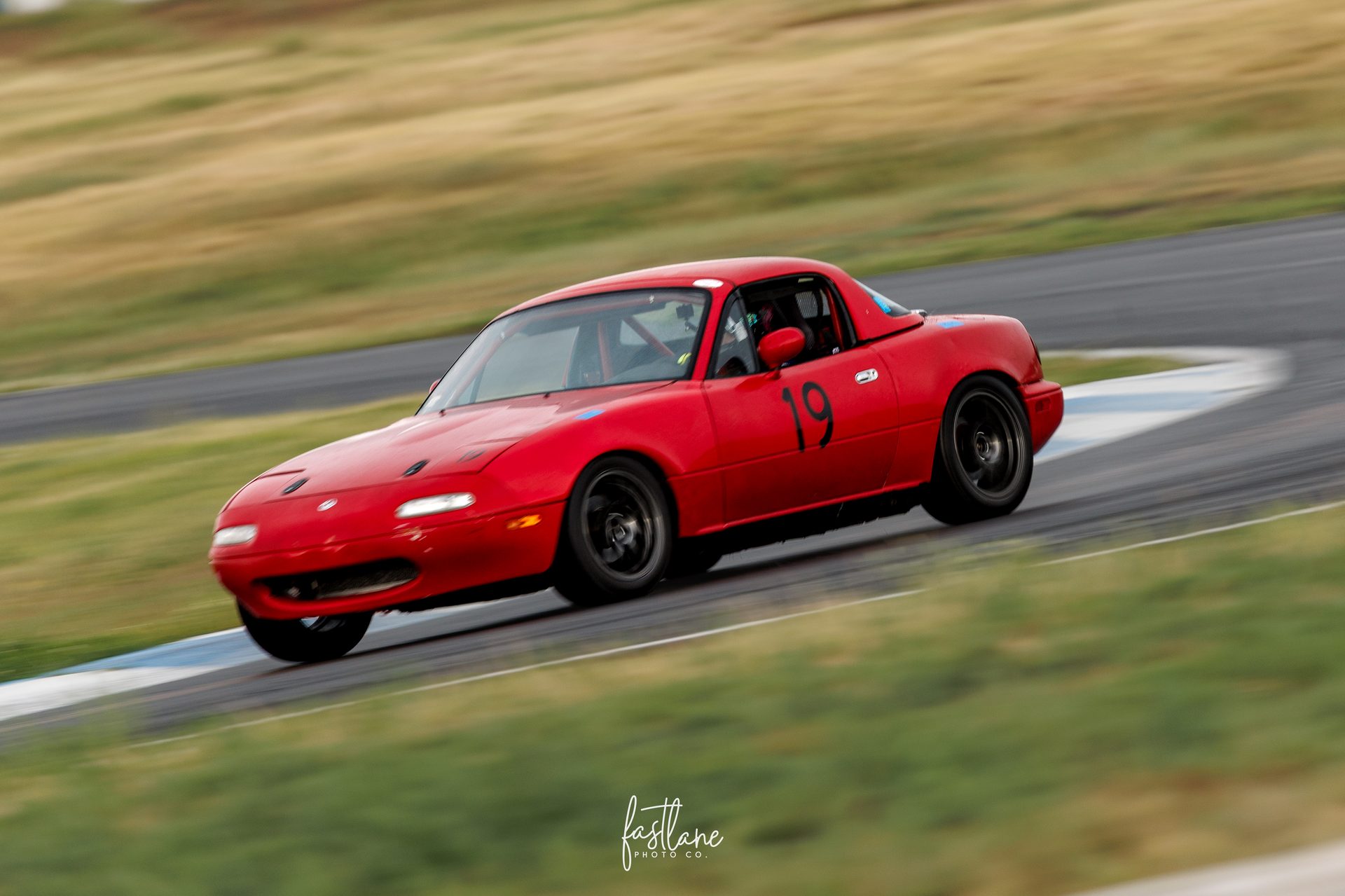
The racing line, in one sentence
The racing line is the fastest path around a track. For most corners, that means you start on the outside edge, clip the inside at the apex, and let the car drift back out to the outside edge on the exit.
Why the whole width? Because a wider arc is a bigger circle. A bigger circle lets the car carry more speed for the same grip. You're making the corner straighter than it looks on the map.
You can often see the line before you drive it. It's the dark, rubbered-in strip that every car before you has laid down. Walk any track, from High Plains Raceway to your local kart track, and you'll spot it. We go into that in how to walk a race track.
The four parts of every corner
Every corner breaks down into the same four points. Your instructor will use these names on day one.
- Braking point. Where you slow down, in a straight line, before the corner.
- Turn-in point. Where you first start turning the wheel. Most beginner mistakes start here.
- Apex. The point where the car is closest to the inside of the corner. It's also where the car is turning tightest.
- Track-out. Where the car reaches the outside edge on the exit, with the wheel unwinding and the throttle on.
Get these four right and the corner almost drives itself. Get the turn-in wrong and the other three fall apart.
Early apex vs. late apex
Here's the part that confuses people. There isn't one apex per corner. There's a range.
The geometric apex sits at the middle of the corner. It's the biggest possible arc. On its own, it's the fastest way through one isolated corner.
An early apex happens when you turn in too soon. It feels natural, so nearly every novice does it. The problem shows up on the exit. You hit the inside before the car has finished turning, so it's pointed at the outside wall. You run out of road, you lift or add steering, and your speed onto the straight is gone. Wikipedia's racing line entry calls the early apex largely a beginner's mistake, and the coaching sources agree.
A late apex means you turn in a little later and clip the inside further around the corner. You give up a bit of entry speed. In return, the exit is straighter, so you can get to full throttle sooner. HPAcademy puts the gain at perhaps 2 to 3 km/h more exit speed, and says the late apex more often than not works out to be the faster line.
That's why HPDE instructors teach beginners a late apex. It's faster on most corners. It's also safer, because if you get it wrong you have track left on the exit instead of grass.
If you're running out of road on exit with lots of steering lock, you apexed too early. If you never get near the outside edge, you apexed too late.
That self-check comes from HPAcademy. You can feel it from the seat with no data at all.
Not every corner is equal
Once you can drive one corner, the next skill is knowing which corners to care about.
Driver61's rule is simple. The corners that lead onto long straights matter most. Any speed you carry out of them stays with you all the way to the next braking zone. A slow exit there costs you the whole straight.
Next come the corners at the end of a straight. Last are the corners that lead right into another corner. For those, a good apex speed is enough. Set them up to help the next turn rather than chasing every tenth.
So in a series of corners, you'll often give up a little in the first one to nail the one that opens onto the straight.
A few other things change the line too:
- Rain. The rubbered-in line gets slick when wet, so drivers move off it. We cover that in racing in the rain.
- Your car. In general, a low-power car like a Spec Miata rewards carrying speed through the middle. A high-power car often wants a later apex so it can use that power sooner.
How to start driving the line
You don't learn the line by reading about it. You learn it in a car, one corner at a time.
Pick the corner before the longest straight and make it your project for a session. Find a fixed reference for your turn-in, like a cone, a crack or a sign. Turn in at that mark every lap. Then move it a car length later and feel what happens on the exit.
Keep your eyes up. Your hands follow your eyes, so look at the apex before you reach turn-in and at the exit before you reach the apex. Our guide on where to look on track breaks that sequence down.
Get an instructor in the right seat if you can. Ross Bentley notes in his Speed Secrets column that late-apex advice is often, but not always, over-prescribed. The finer points, like the car's angle at the apex and how you release the brakes, come later. A coach will tell you which ones matter for you now.
Write down your turn-in marks after each session. Your memory of a corner fades by lunch. If you want a place to keep those notes along with the rest of your weekend prep, the free Race Day Ready Pack puts prep, packing and setup tracking in one place.
Do you believe?
Sources: Wikipedia: Racing line, HPAcademy: Understanding the Apex, Speed Secrets: Do I need to turn in late to get to a late apex? (Ross Bentley), Driver61: Prioritising Circuit Corners. Technique guidance checked October 2026. Every car and corner is different, so treat these as starting points and work them out with an instructor at your own track.