
The sky opens up halfway through your session. The flagger doesn't pull anybody in. Everyone else keeps circulating, so you keep circulating, and suddenly the corner you've been nailing all morning tries to spit you off the outside.
Nothing about your driving got worse. The track just moved the grip somewhere else. And nobody told you where.
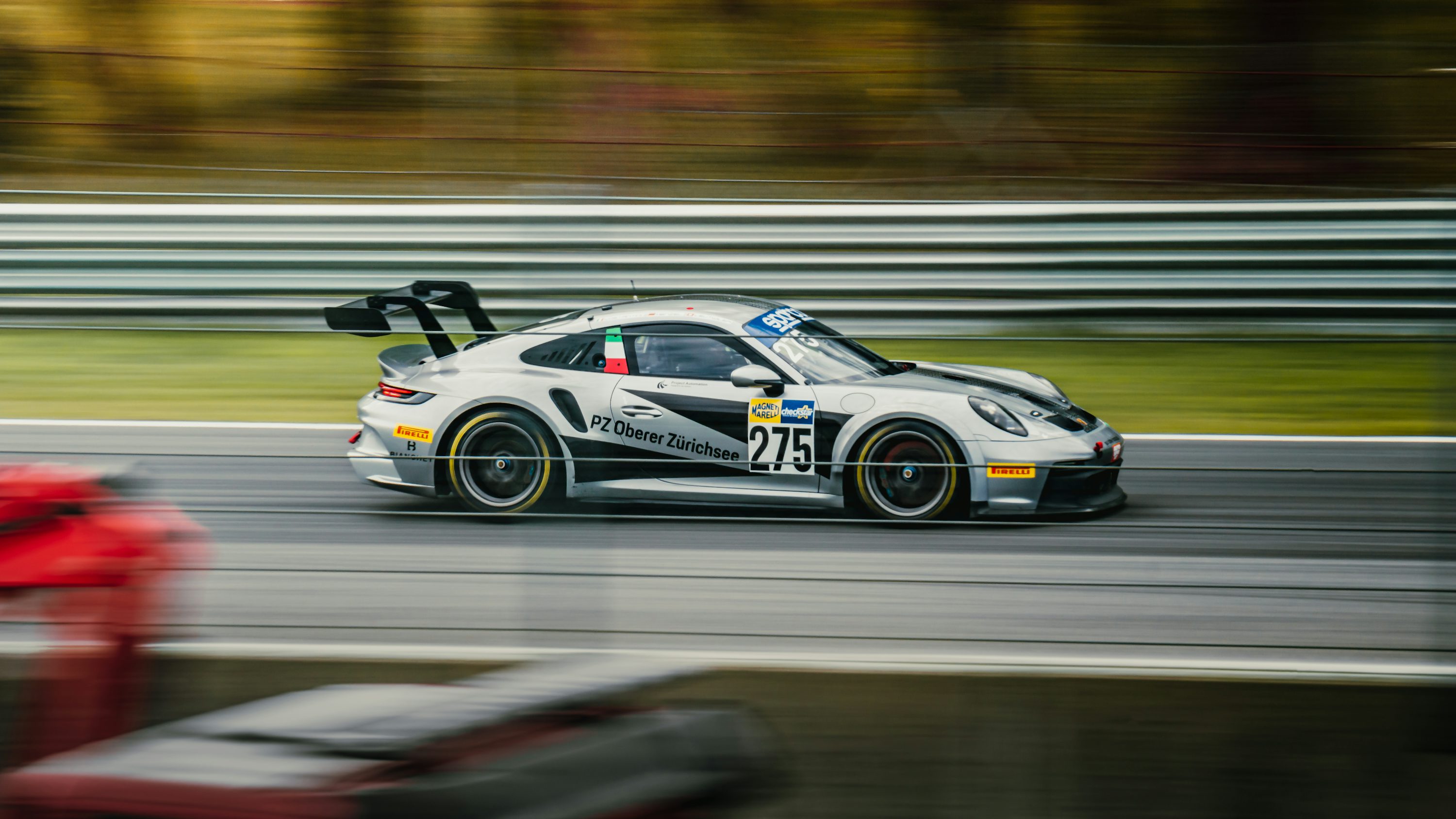 Photo by Isaac Maffeis on Unsplash.
The racing line becomes the slickest part of the track
This is the part that catches everybody.
All weekend, cars lay rubber down on the ideal line. That rubber is a good thing when it's dry. Add water and it turns against you. Coach Dion von Moltke explains it well in the Blayze rain guide: rain pulls oils up out of the rubber to the surface, and the most-used strip of pavement turns greasy.
Braking zones are worse. Years of hard braking polish the asphalt smooth right where you need it least.
So the fast dry line and the fast wet line are often two different lines. That's the whole puzzle.
In the wet, you're not looking for the geometric line. You're looking for the grip.
Start a car width off — then go hunting
Here's the practical method, and it's not "memorize a wet line."
Start by trying your normal line. Wet doesn't automatically make it the worst option, and if you're on a track with a coarse, grippy surface it may still be the best one. Test it at seventy percent and feel what the car tells you.
Then move. Race & Track Driving suggests offsetting roughly a car width off the dry line as a starting point, and about half a car width in braking zones to get off the polished pavement. That's a starting point, not an answer.
From there, look for these:
- Rough or different-colored pavement. Newer patches and coarse surfaces drain and bite better than polished asphalt.
- Anywhere water isn't standing. Water pools in the low spots and along the inside of some corners. Camber tells you where it runs off.
- Unpainted concrete curbing. Painted curbs turn into ice in the rain — stay off them, especially on exit. Bare concrete with drainage grooves can actually be quicker.
Cross the slick strip once, on purpose, in a straight line. Then live on the grippy side of it.
Your inputs get slower, not smaller
Beginners hear "be gentle in the rain" and interpret it as "do everything a little bit less." That's not it. You still brake hard, you still turn. You just take longer to build every input and longer to release it.
Three changes that matter more than anything else:
Keep your hands straight when you cross low grip. Von Moltke's core point is that anytime you're crossing a slick strip, you want the wheel as close to straight as you can. A car being asked to brake, turn, and cross grease all at once is the car that ends up backwards. That often means turning in later and more decisively, then unwinding fast and driving off the exit.
Ease off the brake earlier. Excessive trail braking in the wet is how you get lockup and lose steering entirely. Get more of your braking done in a straight line, then release smoothly to bring the front end back.
Use a taller gear. Short-shifting one gear up softens how fast the engine can break the rear loose. You can do the same thing with your right foot, but the gear does it for you when you're busy.
And if you aquaplane, do nothing dramatic. Don't stab the brakes. Straighten the wheel, lift gently, and wait — the tires will find the pavement again. Panic inputs during aquaplaning are what turn a scary moment into a wrecked car.
Tires and pressures actually change
You don't need dedicated rain tires to run in the wet, and most club-level drivers never buy any.
Grassroots Motorsports puts the optimum road-course pressure for a DOT tire somewhere in the 34 to 42 psi range depending on how heavy the car is — wet or dry. What changes is how much the pressure climbs. Plan on roughly 5 psi of build in the wet versus about 8 in the dry, because you're generating far less heat. So your cold starting pressure needs to be higher than usual to land in the same window hot.
There's a second reason to run a little more air: a slightly over-inflated tire crowns up in the middle like the hull of a boat and cuts through standing water better than a flat contact patch.
A real rain tire has deeper voids and heavy siping to move water. A dry-weather race tire has big solid blocks and nowhere for the water to go. If there's standing water, that difference is enormous. If it's merely damp, or if a dry line is starting to appear, the dry tire is fine or even better.
That's the same temperature story that's playing out on your out lap every session — if you haven't read it, how tires build temperature is the other half of this.
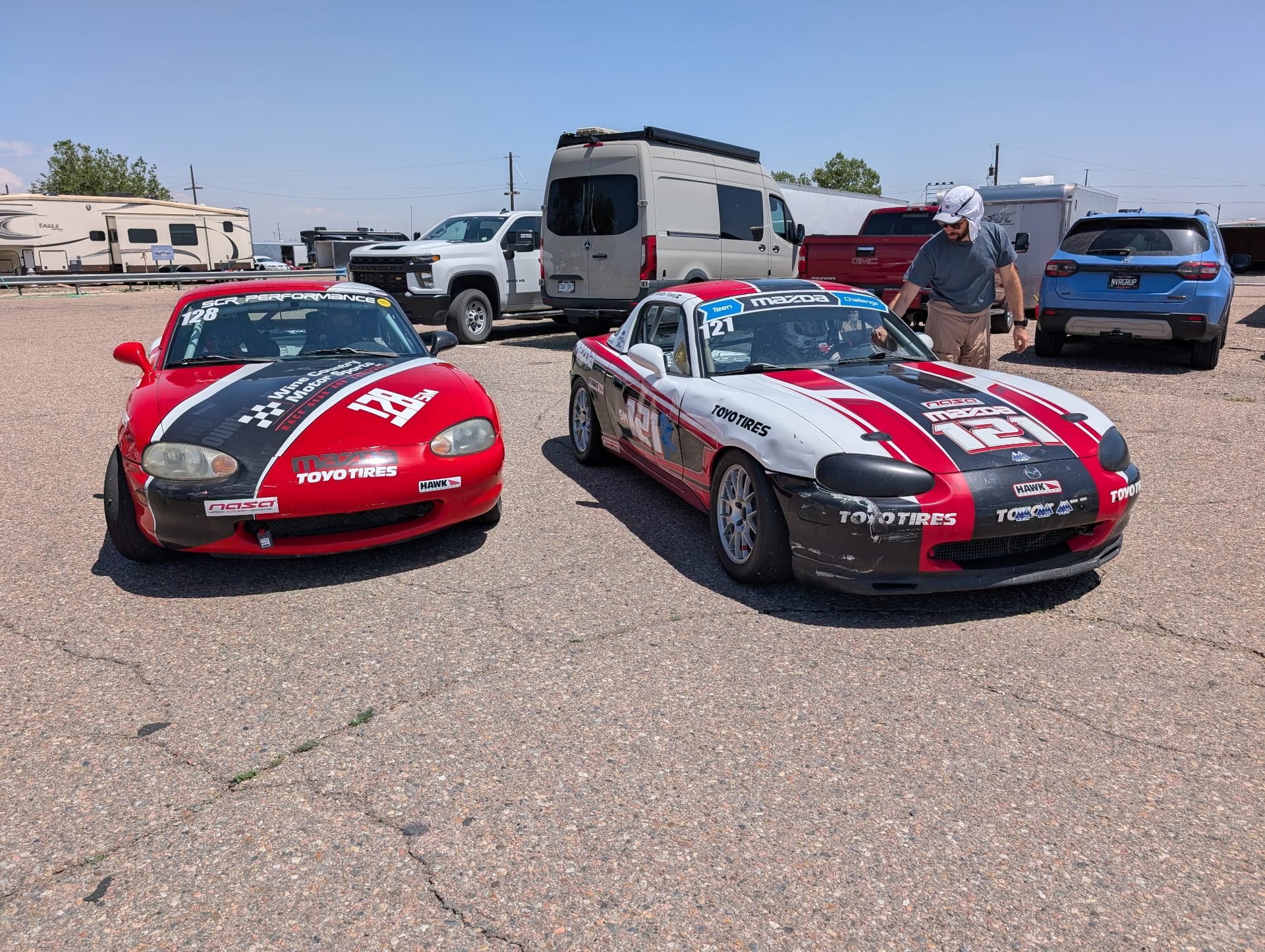 Paddock at the end of the day. Half of racing in the rain is deciding whether to go out at all.
You can't drive what you can't see
Visibility beats technique in the rain. It doesn't matter how good your wet line is if the inside of your visor is fogged over.
- Treat the outside of your visor and windshield with a rain repellent so water beads and blows off.
- Use a real anti-fog on the inside. Body heat plus a closed car plus cold rain equals fog within a lap.
- Crack a window or a vent if your car allows it.
- Leave enormous gaps. The rooster tail off the car ahead can completely erase your view of the braking zone. Following close in the wet is how a lot of first-time rain contact happens.
If you're racing wheel to wheel, know your club's rain light rule. Both SCCA and NASA require a rear-facing rain light that gets switched on when officials call for it, and the specific wording is regional. Read your rulebook before you need it, not in the grid line.
Will they even run?
Usually, yes. Club racing and HPDE are largely rain-or-shine sports, and a wet session is still a session you paid for. What actually stops the day is lightning, fog, or standing water deep enough to be dangerous — and then it's a red flag and a wait, not a refund.
That decision is yours, too. If you're a first-timer in your street car with all-seasons and no experience, sitting out one wet session is a completely legitimate call. Nobody at the track will think less of you. There's no trophy in HPDE.
If you do go out, go out on purpose. Slow lap, learn where the water sits, build from there.
The Colorado wrinkle: we don't get much of this. High Plains Raceway and Pueblo sit out on dry, high plains, and most of our race weekends run under blue sky. But summer afternoons out here can hand you a thunderstorm that soaks the track in ten minutes and then dries it out almost as fast. That means two things. One, the whole field is short on wet experience, so the driver who's practiced is genuinely at an advantage. Two, you'll often be chasing a drying line rather than a soaked one — and once a dry strip appears, the fast line snaps back toward the normal line. Follow where the other cars are actually going, not the wet line you memorized twenty minutes ago.
Rain is the cheapest driver development there is. It forces smooth hands, patient throttle, and real feel, all at speeds low enough that mistakes are survivable. Almost every driver I know who's good in the wet got good because they stayed out when they wanted to come in.
If you'd rather learn it in a car that's already sorted, with a crew and a coach reading conditions with you, that's what our arrive and drive program is built for.
Sources: Blayze — Racing in the Rain, Race & Track Driving — Rain Line, Grassroots Motorsports — 9 Setup Changes for the Wet, SCCA — Cars and Rules. Technique and setup guidance verified against current published coaching and club sources as of September 2026, plus our own time in the car. Rain light and weather-stoppage rules vary by region — always confirm with your sanctioning body.
Do you believe?