
Every instructor tells beginners the same thing. Learn car control before you learn speed.
Almost nobody tells you where you're supposed to do that. You can't practice a slide on the highway, and a track day is the wrong place to discover what the back of your car does when it lets go.
The answer is a skid pad. Most drivers have never heard the term.
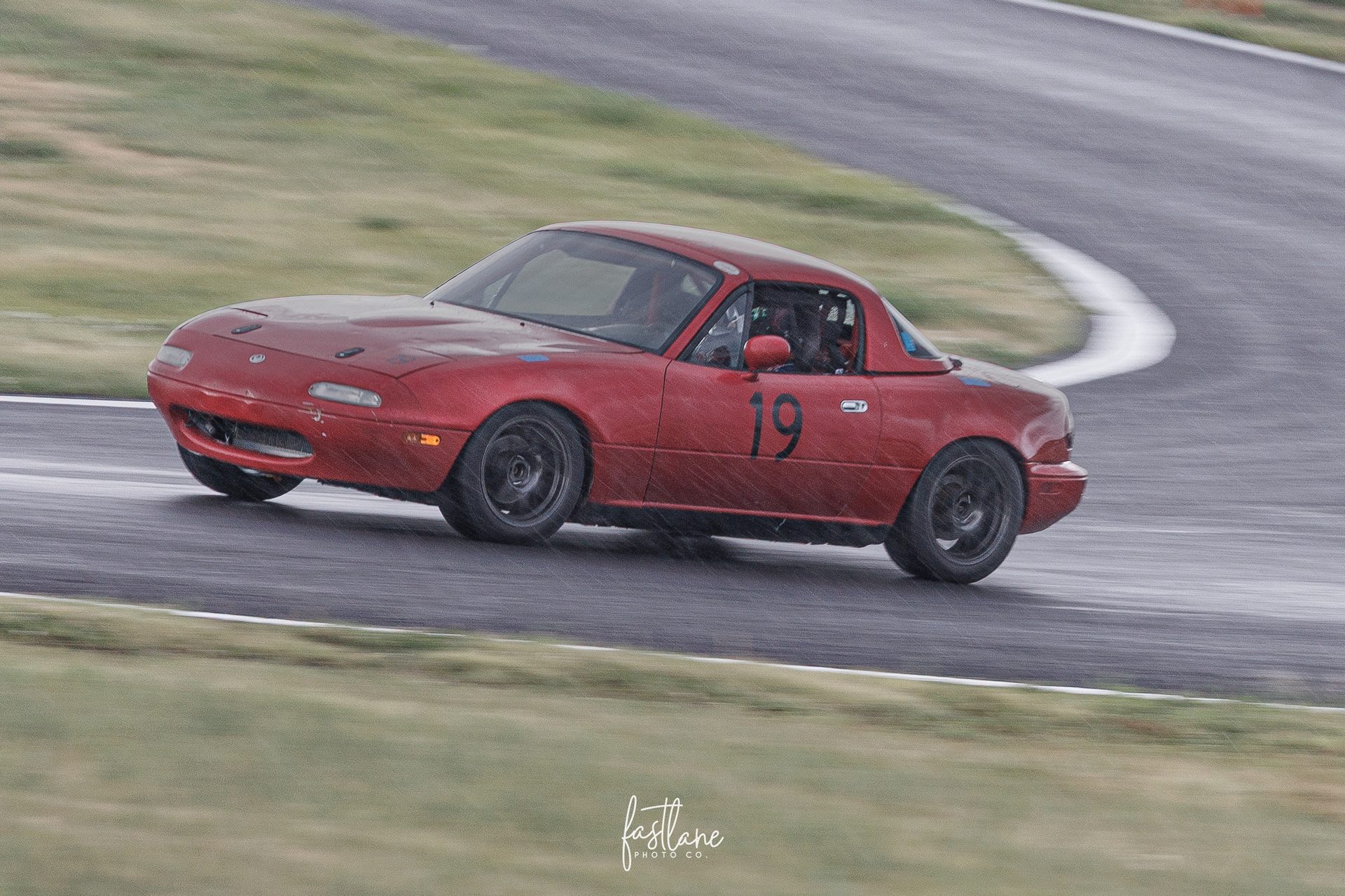 Our #19 in the wet at High Plains Raceway, August 2026. Low grip is a great teacher. It's a much better teacher when the speeds are low and there's nothing to hit.
What a skid pad actually is
A skid pad is a big paved circle in the middle of an empty lot. Many have sprinklers.
That's it. No walls, no other cars, nothing to hit.
The sprinklers are the whole trick. Wetting the pavement drops the grip so far that the tires give up at 25 or 30 mph instead of 75. Most clinics keep you under about 35 mph. You're driving at the absolute limit of the car the entire time, just at a speed where a mistake means a spin and a laugh instead of a tow truck.
Low grip also sharpens the lesson. The National Capital Chapter of BMW CCA makes this point about their wet pad work: on a slick surface the breakaway happens more distinctly, so the margin between gripping and sliding is easier to feel and easier to catch.
A skid pad is the only place in your life where losing control is the assignment.
What you actually do at a car control clinic
You don't just spin in circles for six hours. A real clinic runs stations, and you rotate through them with an instructor in the passenger seat.
The standard set looks like this:
- Threshold braking and ABS. Stand on the pedal from 40 mph and find out what full braking feels like. Most drivers have never once used all of their brakes.
- Emergency lane change. Brake hard, then steer around something, then get the car settled again.
- Slalom. Cones in a line. This is where weight transfer stops being a diagram and becomes a feeling in your hips.
- The wet pad. Understeer first, then oversteer. You induce it, you recognize it, you correct it. Over and over.
- Two wheels off. Some venues add a recovery drill for when you put two wheels in the dirt.
The wet pad is the part people remember. It's also the only cheap way to get fifty repetitions of catching a slide in one afternoon. If understeer and oversteer are still abstract words to you, here's what each one actually feels like through the wheel and the seat — and a pad is where you go to confirm it.
What a car control clinic costs
These are published 2026 rates from real organizers, not estimates.
| Program | Price | Notes |
|---|---|---|
| Thunderhill car control clinic | $150 per driver | Your own street car. Loaner helmets available. Open to teens through seniors. |
| Tire Rack Street Survival | $175 | Ages 15–21, permit or license. Coach in every student's car. No helmet needed. |
| SCDA car control clinic (Lime Rock) | $369 | Wet skid pad plus an autocross course. SA2020 helmet required, 24 drivers max. |
| Club clinics (SCCA regions, BMW CCA chapters) | roughly $125–$150 | Often includes lunch. Membership may be required. |
That's the cheapest instruction in motorsports. A full day of coached limit-handling for less than one set of race tires.
Street Survival deserves a callout if you have a teenager. A coach rides in the student's own daily driver all day — not a race car, the car they actually drive to school.
The honest Colorado situation
Here's where I stop being a cheerleader.
I can't point you to a dedicated public wet skid pad in Colorado. The Rocky Mountain Chapter of BMW CCA has historically run a car control clinic, but they cancelled their 2026 autocross season outright. I found no 2026 Tire Rack Street Survival school scheduled in Colorado either, though their site lets you request one for your area.
So the practical Front Range path is a workaround, not a skid pad:
- Autocross. Rocky Mountain Solo runs events at Colorado Air and Space Port in Watkins and at PPIR. A 2026 fun event listed at $60 standard, $55 military, with a novice course walk in the morning. It isn't a wet pad, but it's low-speed limit driving with cones instead of walls, and it's the best $60 in the sport. Autocross versus HPDE versus racing breaks down which one fits where.
- Winter. Snow-covered lots and the frozen-lake gymkhana events some clubs run are skid pads that nature installed for free. Same lesson, colder.
- Teen driver programs. MasterDrive in Colorado Springs runs closed-course vehicle dynamics training with a skid component. They don't publish pricing, so call them rather than trusting a number you read somewhere.
- HPDE with a real instructor at High Plains Raceway or Pueblo. Not the same thing, but it's supervised seat time.
Is one day enough?
No, and anybody who tells you otherwise is selling something.
The BMW CCA instructors are blunt about this: car control is a skill that takes time and repetition, and a single session doesn't hand it to you. What one clinic day buys you is recognition speed. You've felt the front end wash out before, so the next time it happens at 80 mph on cold tires you're not surprised — you're just busy.
That's a real thing to own before your first track day. It costs $150.
When you've done the cheap limit work and you want a coached seat in an actual race car at an actual NASA weekend, our arrive-and-drive program is the tier above all of this. Fair warning: that's a $5,000 weekend, and it is not the next step for most people. The $60 autocross is.
Go find some grip and then go lose it on purpose.
Sources: Tire Rack Street Survival FAQs, SCDA Car Control Clinic, Thunderhill Car Control Clinics, National Capital Chapter BMW CCA skid pad instruction, RMC BMW CCA, SCCA Rocky Mountain Solo, MasterDrive Colorado. Prices are published 2026 rates verified in September 2026 and will vary by venue and date. MasterDrive does not publish program pricing, so no figure is quoted for it here.
Do you believe?