
The $1,500 donor Miata is mostly a story people tell about 2012.
You can still find a $1,500 Miata. It'll be a rust-belt car, a salvage title, or something that doesn't run. And in Spec Miata, the shell you're buying is the whole purchase. Get that wrong and the build is over before it starts.
Here's what a build from a donor actually costs right now, line by line, with the sources.
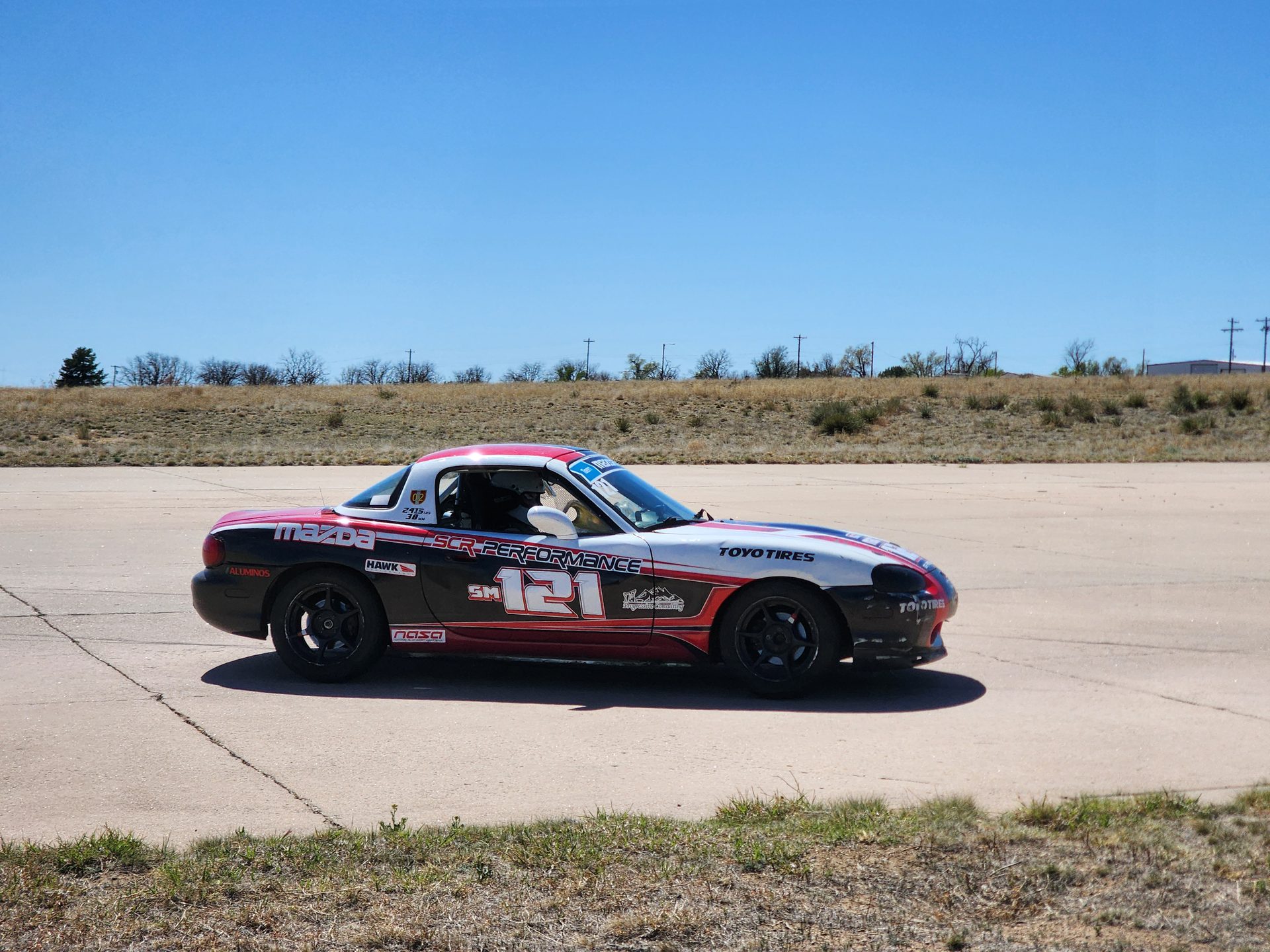 Our #121 — a finished Spec Miata. Every car on a Spec Miata grid started as somebody's used Mazda.
The donor is the cheapest part of this
Four generations are eligible: the NA6 (1990-1993), the NA8 (1994-1997), the NB1 (1999-2000) and the NB2 (2001-2005), per spec-miata.com.
What a donor costs depends on what you're willing to fix. Planet Miata, which builds these cars for a living, publishes a current donor range of $4,000 to $6,500. Clean running cars out of the south have been reported cheaper, around $2,500 to $3,500, though those figures come from forum threads and are a few years old. A stripped rolling shell can be close to free.
The thing you're really buying is the tub. Un-crashed, un-rusted, straight. Rust-belt cars rot in the front frame rails right where the sway bar brackets tie into the unibody, and that's not a "we'll deal with it later" problem.
Cosmetic ugliness, though, is your friend. Street buyers don't want torn seats and faded paint. You're throwing all of that in the dumpster anyway.
If you want the full inspection routine, our used Spec Miata buyer's guide walks the same checks.
The parts list is the real number
Here's the figure that ends most build fantasies. Spec Miata's own cost page puts the full parts list to build a basic car at about $15,000 — and that's explicitly "with no labor, just donor car and required parts."
That $15,000 isn't upgrades. It's the stuff that makes it a race car:
- Welded-in cage, seat, camlock harnesses, window net, fire system, master cutoff
- Shocks, springs, sway bars, bushings, end links
- Brakes, pads, stainless lines, high-temp fluid
- Limited-slip differential, rebuilt transmission, clutch, flywheel
- Exhaust, gauges, wheels, tow hooks, plumbing
- Alignment and corner balance
Then there's the hardtop. Published Spec Miata rules language says the convertible top and its hardware must come out, and the factory detachable hardtop is permitted but not mandatory. Almost every competitive car runs one anyway. Planet Miata budgets $2,000 to $2,500 for it. Pull your own current rulebook from NASA before you buy anything — class rules move.
So before a single hour of labor: roughly $5,000 donor + $15,000 parts + $2,000 hardtop. Call it $22,000.
Labor is where the build quietly doubles
Spec Miata's cost page puts a professional build at about 120 hours of labor.
Do that math at any real shop rate and it stops being a rounding error. A Colorado performance shop we've tracked publishes $240 an hour. Even at $150, 120 hours is $18,000.
The cage is the clearest example. You can buy a seven-piece mandrel-bent tubing kit from Advanced Autosports for $681 and source the straight tube locally. A full weld-in kit from Miatacage is $1,925 with landing perches, gussets and door bars, and they publish a realistic install time: 18 to 20 hours for one person with fabrication skills.
If you have those skills, the cage is a $2,000 problem. If you don't, it's a fabricator's invoice. Older forum threads quote $2,000 to $2,500 for cage installation labor, but those numbers are from 2015 to 2019 and shop rates have not gone down since. Get a written quote, not a forum number.
Same story for a cage on a street car, which is a different question entirely — we covered that in do you need a roll cage for a track day.
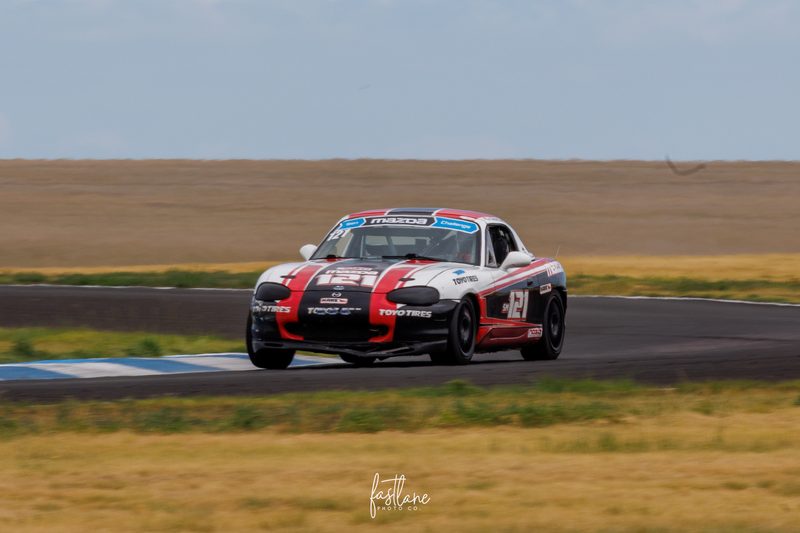 The part nobody budgets for: the car still has to be run after it's built.
Build versus buy, side by side
| Build from a donor | Buy used, race-ready | |
|---|---|---|
| Donor / purchase | $4,000-$6,500 | $10,000-$45,000 |
| Hard parts | ~$15,000 | included |
| Hardtop | $2,000-$2,500 | usually included |
| Labor | ~120 hrs (yours or paid) | zero |
| Time to first green flag | 12-16 weeks pro, longer DIY | next event |
| Pro-built equivalent | $42,950 excl. donor + hardtop | — |
Those last two rows are the honest verdict. Planet Miata's published price for a 1990-2005 build, excluding donor and hardtop, is $42,950 with a 12-to-16-week timeline. Spec Miata's own page says a front-of-the-pack professional build runs $55,000 to $60,000.
Meanwhile used race-ready cars sell for $10,000 to $45,000, and entry-level cars start around $8,000. Current RacingJunk listings for sorted, race-ready cars sit in the low-to-high twenties.
That gap is the point. The Grassroots Motorsports paddock consensus is blunt about it: you almost never get your build money back, which means somebody else's investment is for sale below what it cost them.
You don't get build money back. That's exactly why buying used is cheap.
When building is still the right call
Building isn't a mistake. It's a different purchase.
Build if you have the skills, the tools, the space and eighteen months of patience — especially if you're spending that time getting licensed anyway. A car you built is a car you know. Every torque spec, every weld, every part with a date on it. We built our #19 that way, and I'd do it again. That story is in Meet Ike.
Buy if what you actually want is seat time this season.
And if the honest answer is that you want to drive and not fabricate, that's what Kart to Car exists for. We provide the car, the crew and the coaching. Plenty of fast drivers are not fabricators, and there's no rule saying they have to become one.
The number after the number
The build is not the end of the spend. It's the beginning of it.
Spec Miata publishes per-weekend running costs of about $1,250 for tires, $500 entry, $300 for a test day, $250 in fuel and fluids and $350 in brake pads. Our own ground truth matches: a competitive weekend is a minimum of about $2,500 in consumables, and $2,000 to $3,500 all-in is realistic when you do your own wrenching. The tire cost breakdown has the detail, and the hidden costs post has the rest.
For scale: our arrive-and-drive weekend is $5,000 for a standard car, $6,500 for the championship #121, with crew, coaching and data included. Six of those is less than a front-of-pack build — and you never buy a trailer.
None of that means don't build. It means build with the whole number in front of you, not the donor price.
If your wall is the money and not the wrenching, the fastest thing you can do this week is get one good pitch in front of one real company. Before you send it, send it through The Pitch Inspection — $39, and you get your actual email or proposal back marked up in writing by the team that pitches sponsors to fund these exact cars, plus a rewritten opening you can paste and the three fixes that move your reply rate.
A donor car is the easy part. Funding the build is the skill.
Sources: Spec Miata — Costs, Spec Miata — Build a Spec Miata Race Car, Planet Miata — Spec Miata Build Process, Miatacage roll cage kit, Advanced Autosports standard roll cage DIY kit, RacingJunk Spec Miata classifieds, Grassroots Motorsports forums, NASA rules. Parts, donor and build prices verified against published vendor and builder pages as of September 2026. Cage-labor figures are forum-reported and dated — get a written quote. Southern donor pricing and the build-versus-buy consensus are paddock sentiment, not survey data. LFR arrive-and-drive pricing and our own consumables floor are our real published numbers.
Do you believe?