
You find the perfect sponsor. Right product, right audience, right size. Then you see their decal on the quarter panel of the car you raced last month.
Most racers close the tab right there.
That's the mistake. You just found the one brand in your entire prospect list that has already proven it writes checks to people exactly like you.
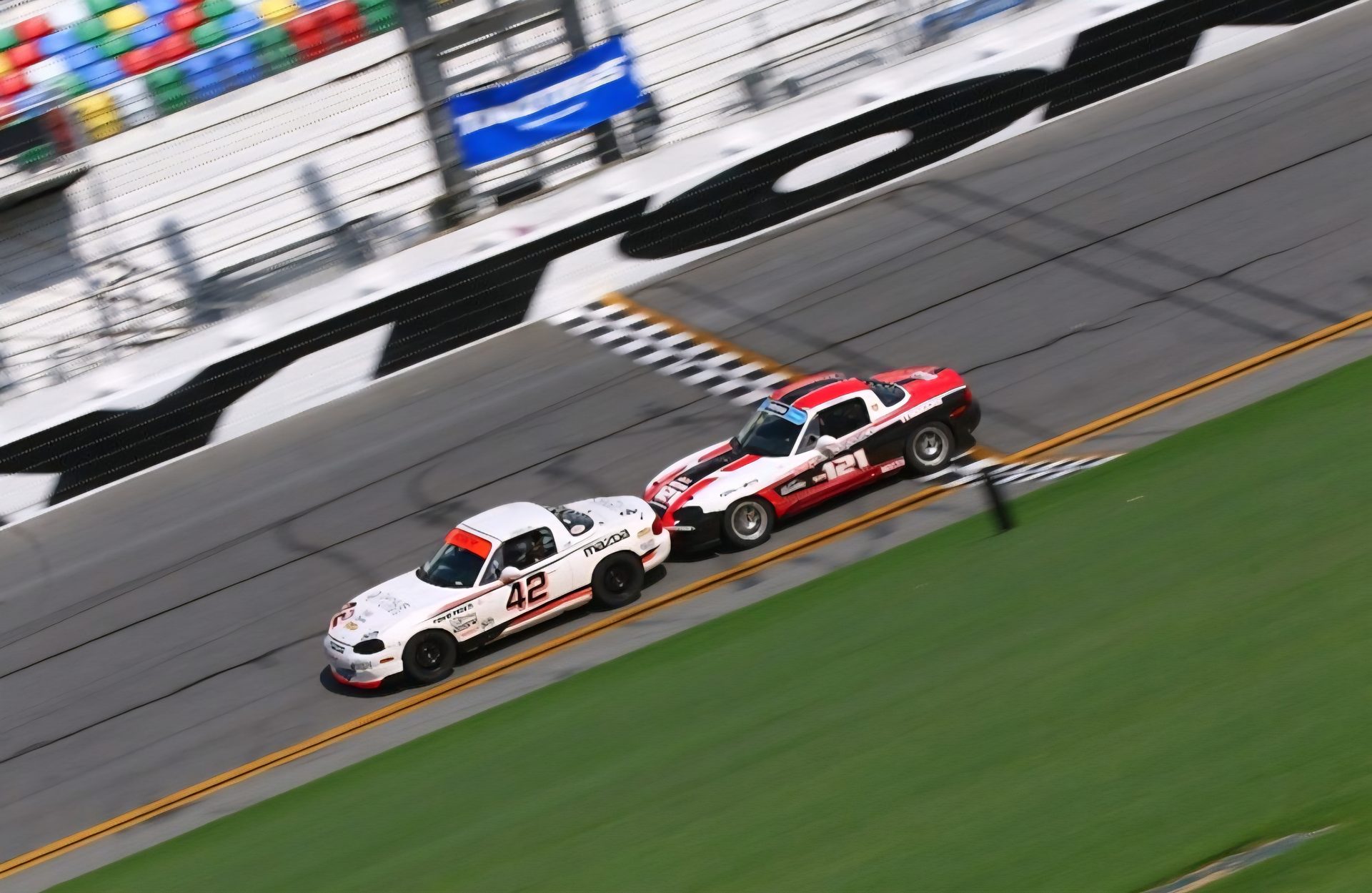 The car next to you isn't blocking your sponsor. Usually it's the proof your sponsor exists.
"One sponsor per class" is a rule racers made up
Nobody in the industry believes this except us.
Look at how motorsport actually funds grassroots racers. NHRA's 2026 contingency program has more than 100 manufacturers and retailers putting up more than $11 million in cash to pay racers who run their parts and their decals. Not one racer each. Every racer who qualifies, in every class, at every event.
Road racing works the same way. SCCA's 2026 road racing contingency programs list Hawk Performance, Summit Racing, Goodyear, Pirelli, Mazda, Toyota Racing Development, Nissan, Hoosier and more. Hawk alone pays product certificates down to fifth place — $150, $125, $100, $75, $50. Mazda's cash payouts run roughly $100 to $600 depending on class. Registration is free.
Read that again. These brands deliberately fund five drivers in the same race.
The ambassador and dealer programs we're in are built the same way. They exist to include more than one racer, on purpose, because a brand doesn't want one car. It wants presence across a paddock.
A brand that already sponsors a racer in your class has a budget line, an approval process, and a boss who has already said yes to this exact kind of spend. That's the hardest part of sponsorship, and it's already done.
Find out what's actually blocked before you assume anything
Here's what most racers do: see a decal, assume exclusivity, quit.
Here's what's usually true. That deal is one of these:
- Contingency or a racer-support program. Open to anyone who registers and runs the decal. Zero exclusivity. You can sign up today.
- Product support, not cash. They send parts. The marketing budget is untouched.
- A regional or single-event deal. Their money is in one series, one region, or one weekend.
- A narrow category deal. Exclusivity is scoped by product category, not by sport — and categories are narrower than racers think.
- A genuine exclusive partnership. This one is real. It's also the rarest of the five.
You can find out which one it is in about twenty minutes. Read the other racer's public posts. Read the brand's motorsport page. Look for the word "program" — programs are almost always open.
Or just ask the brand. Kim Skildum-Reid's advice on multi-brand sponsorship is to say it straight: ask whether they'd treat it as one deal or two. Brands answer that question honestly, because it saves them time too.
Never pitch against the other racer. Pitch a gap.
This is the part that decides everything.
If your email says "I'd be a better investment than the guy you have," you're done. You've told a brand that their last decision was dumb, and you've told them exactly how you'd talk about them if it ever went sideways. We don't do that here, and it doesn't work anyway.
You're not trying to replace anybody. You're trying to be a second line item.
The B2B buying research is brutal about why this matters. Forrester found 92% of B2B buyers start with at least one vendor already in mind, and 6Sense found the vendor ranked first wins about 80% of the time. Incumbents win. Fighting one head-on is the worst odds in sales.
So don't. Find the gap instead:
- Region. They're covered in the Southeast. You run NASA Rocky Mountain. Different track, different customers, different tire shops.
- Series. Their racer runs SCCA nationals. You run a regional weekend series with a completely different crowd walking the paddock.
- Audience. Their racer is 34 with a car-enthusiast following. You're 17 in Teen Mazda Challenge with parents in your comments. Those are two different marketing budgets.
- Job. Their racer delivers podiums. You deliver content — build videos, a media kit, an activation at the sponsor's own storefront.
- Sibling brand. Big companies run divisions that barely talk to each other. The oil brand said no; the additive brand under the same roof has its own manager and its own budget.
Every one of those is a sentence you can say out loud without insulting anyone.
If you're staring at your draft right now and can't tell whether it reads as "second line item" or "replace your guy," that's exactly what Pitch Teardown is for. Send us the actual email. For $39 you get it marked up in writing within five business days, a rewritten opening you can paste, and the three fixes that move your reply rate most.
The four sentences that open the door
Name the existing deal in your first line. Don't hide from it. Hiding from it is what makes you look like you didn't do your homework.
- Acknowledge it. "I saw you're already backing a car in Spec Miata — that's the reason I'm writing."
- Draw the line. "I'm not asking you to move that. I run the Rocky Mountain region, and your closest shop here has no car in this paddock."
- Name the job. "What I'd give you is [specific thing] — a storefront activation in June and four build videos your team can repost."
- Make it small. "One weekend, $X, and I'll send you the numbers after. If it works, we talk about the season."
That's it. Short, specific, and it never once mentions the other racer as competition.
If they say no because of a category conflict, that's information, not rejection. Ask when the category comes up for renewal and get on the list early. That's not a consolation prize — being on the shortlist on day one is nearly the whole game.
When to actually walk away
Three signals mean move on: a true title partnership, exclusivity written across the whole sport, or a brand that tells you the motorsport budget is spent through next year.
Take the answer, thank them, and put a calendar reminder for eleven months out. Then go spend that energy on the next name. There are more of those names than you think — most racers pitch six brands and quit. The ones who land deals pitch sixty.
If the deeper problem is that you don't have a list of sixty names, or a package, or a follow-up system, that's the whole Get-Funded System — $67, the prospecting, pricing, and closing playbook I wish someone had handed me. And if you're already getting replies but they die at the second email, our post on ranked sponsor objections and the comeback for each covers what to say next.
One more thing worth reading before you send anything: if the brand comes back asking for exclusivity of their own, know what that's worth before you agree.
So here's the ask. Take the brand you crossed off your list because someone else got there first. Put it back on. Then send us the pitch through Pitch Teardown before you hit send — $39 to not waste your one shot at a company that has already proven it funds racers.
That decal on the other car was never a wall. It was a receipt.
Do you believe?
Sources: NHRA — 60 Years of Success: NHRA's Contingency Program Pays Racers to Win, SCCA — Register for These 2026 SCCA Road Racing Contingency Programs, Mazda Motorsports Contingency Programs, Power Sponsorship — Selling Multi-Brand Sponsorship: The Cheat Sheet, RTR Sports — Sponsorships and Product Categories: The Guarantee of Exclusivity, Corporate Visions — B2B Buying Behavior Statistics (citing Forrester 2024 and 6Sense 2025). Contingency figures are the published 2026 program numbers as of August 2026. The buyer-behavior statistics are general B2B research, not motorsport-specific, and are labeled that way on purpose. No LFR customer, sales, or survey data is claimed anywhere in this post, and no named sponsor's private deal terms are described.