
Left-foot braking might be the most over-recommended technique in amateur racing. Someone in the paddock tells you the fast guys do it. They're not wrong. They're just leaving out the part where it depends entirely on what's under your left foot.
If there's a clutch pedal there, the answer changes.
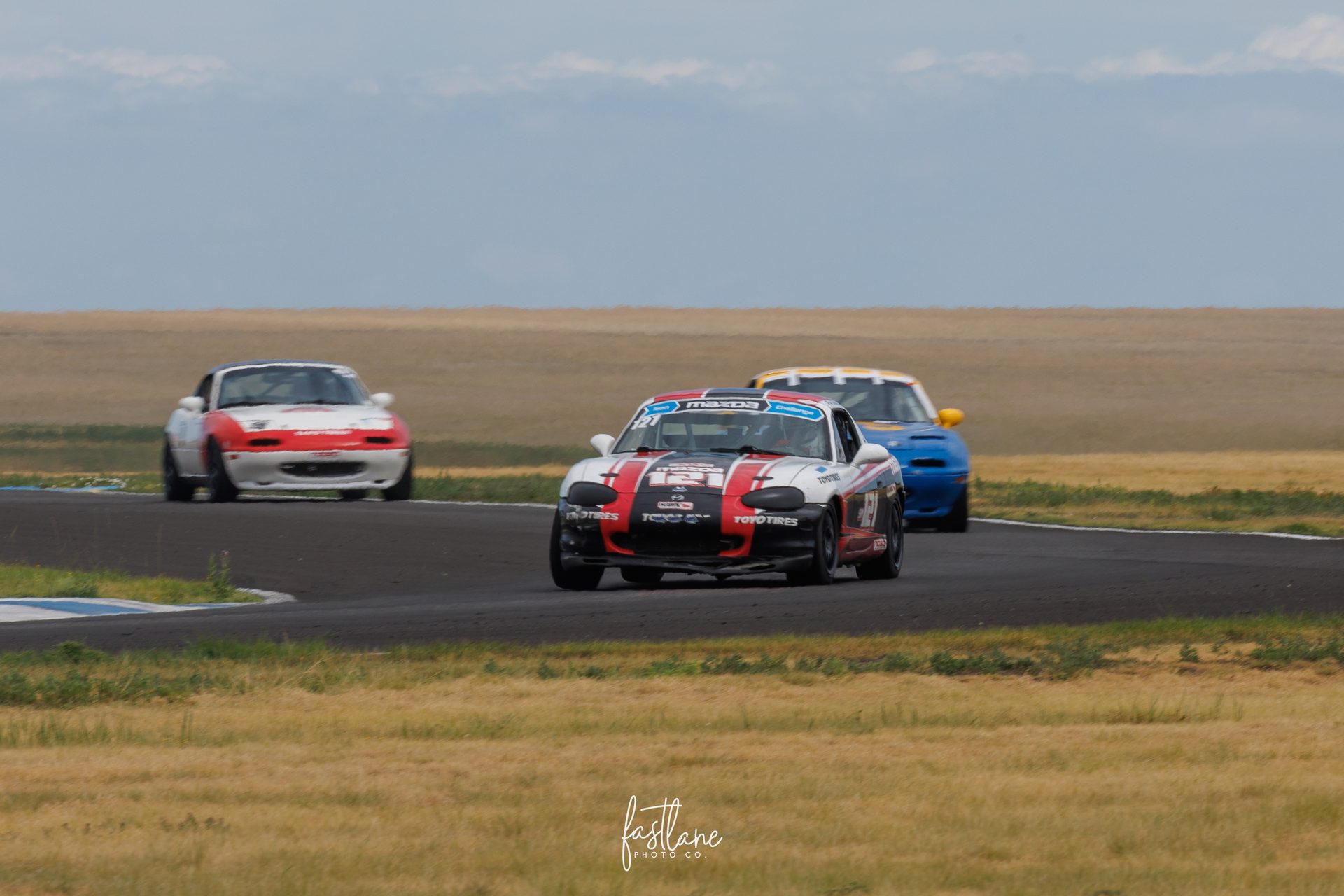 Leading a three-car Spec Miata train at High Plains Raceway. Every one of those braking zones is a right-foot braking zone.
The Short Answer
Left-foot braking means exactly what it sounds like. Your left foot works the brake. Your right foot never leaves the throttle.
Whether that's a good idea comes down to one question: does your left foot already have a job?
In a kart, it doesn't. In a paddle-shift car, it doesn't. In an automatic, it doesn't. In all three, left-foot braking is the correct default.
In an H-pattern manual — a Spec Miata, a Spec E30, most of the club-racing grid at High Plains Raceway on any given weekend — your left foot is on the clutch for every downshift. Which means it's unavailable for almost every braking zone on the lap.
That's not an opinion. It's a pedal count.
What Left-Foot Braking Actually Does
It's worth understanding the mechanism before you decide you want it, because "the fast guys do it" isn't a reason.
It deletes the transfer time. Moving your right foot from throttle to brake takes a tenth or two. Over a lap with twelve braking zones, that adds up. Left-foot braking removes the move entirely.
It smooths the handoff. When one foot comes off the gas and the other is already on the brake, the weight transfer to the front is gentler and more controlled. Less of a lurch, more of a lean. Driver61 makes this point well — you're managing load, not just slowing down.
It lets you overlap. This is the part that matters most. On a fast corner that needs no real braking, you can hold throttle and add a touch of brake at the same time. That loads the front tires and helps the car turn in without dumping the whole car onto its nose.
There are two specialty uses on top of that. In a turbocharged car, holding throttle against the brake keeps the engine on boost. And in front-wheel drive — rally and autocross especially — a stab of left-foot brake kills understeer and rotates the car. That's why rally drivers live on it. The technique traces back decades in that world; Wikipedia credits Finnish rally driver Rauno Aaltonen with using it for Saab back in the 1950s.
Karters Already Do This. That's the Problem.
A racing kart has two pedals. Brake on the left, throttle on the right, no clutch anywhere. Every kid who came up through karting learned to brake with their left foot because the chassis gave them no other option.
Then they get in a car, and the layout betrays them.
Now there are three pedals. The clutch is where the brake used to be. The brake has moved to the right, under a foot that has literally never braked anything. And the muscle memory they spent five years building is now pointed at the wrong pedal.
This is one of the least-discussed parts of the kart-to-car jump, and it's real. The common report from drivers making that switch is a few days to a few weeks of adjustment, with early braking that comes out heavy and jerky. It's not a skill problem. It's a wiring problem.
The fix isn't clever. It's reps, at low speed, before the first session that counts. Same as everything else in this sport.
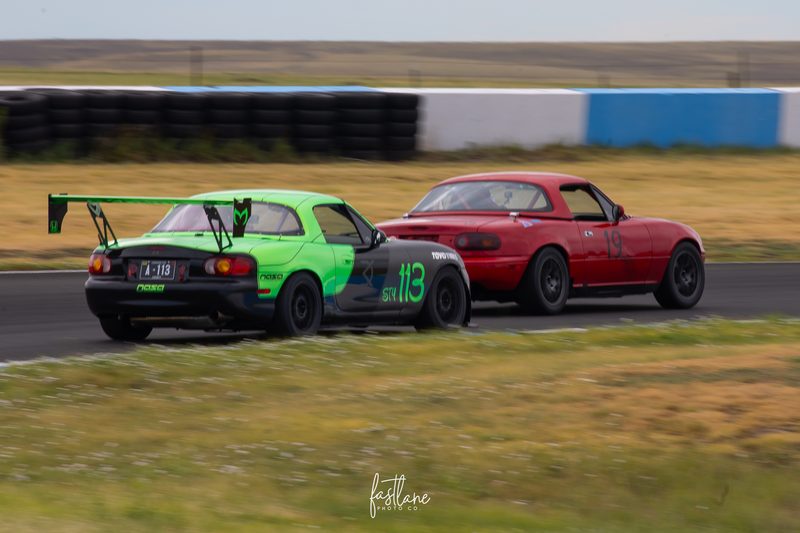 Corner exit in traffic. In an H-pattern car, the brake-to-throttle handoff still belongs to one foot.
Where It Actually Applies
Here's the honest breakdown by car type.
| Car | Left-foot brake? | Why |
|---|---|---|
| Racing kart | Always | Two pedals. No clutch. No choice. |
| Formula car, paddle-shift, sequential | Yes | No clutch pedal in use once you're rolling |
| Automatic street car on track | Yes | Left foot is otherwise idle |
| FWD autocross or rally car | Often | Rotation and trailing-throttle control are worth more than anything else |
| H-pattern manual road racer | Rarely | The clutch owns your left foot in nearly every braking zone |
That last row deserves more than a line.
In a Spec Miata you downshift into almost every braking zone on the track. Brake, clutch, gear, release. Your left foot is committed. The only corners where left-foot braking is even physically available are the ones you take in a single gear — the kinks and the long sweepers where you're lifting or brushing the brake, not stopping the car.
That's two or three corners a lap at most. And the gain in those corners is the smallest gain of any on the track, because you're barely braking there anyway.
If you race an H-pattern car, left-foot braking is a garnish. Treat it like one.
The Calibration Problem Nobody Warns You About
Your left leg is a bracing leg.
Sit in a properly set up race car and your left foot is planted on the dead pedal, holding your torso against the seat so your hands stay free to steer. That's most of its job, and it's a job that rewards force, not finesse. We went through this in detail in the post on racing driving position.
Then you ask that same leg to modulate brake pressure in grams.
It goes badly at first. Every source that teaches this technique says the same thing — the first attempts are too hard and too abrupt, and drivers snap forward against the belts and lose contact with the wheel. The Rocky Mountain Region PCA writeup on it, written by instructors who run the same Colorado tracks we do, is blunt: your left foot lacks the delicate touch your right foot spent years building.
There's a second, physical conflict that follows from this. You cannot brace with a leg and modulate with it at the same time. In a car with a dead pedal and a real seat, switching to left-foot braking means giving up your bracing point every time you brake. That's a genuine tradeoff, and it's the argument I find most persuasive against doing it in a stiff, high-grip car.
And one practical warning: a left foot resting on the brake pedal is a left foot dragging the brake. That cooks pads and lights your brake lights for everyone behind you, which in a close pack is a good way to cause a problem you didn't intend.
How to Learn It Without Wasting a Season
If you're in a car where it applies — paddle-shift, automatic, front-drive autocross car, or you're a karter who wants to keep the skill alive — here's the progression the instructors agree on.
- Start in the off-season, not at an event. This is a winter project. You are not debuting this in a race.
- Start in a road car, in an empty lot, at walking pace. Get the left foot used to a brake pedal with no consequences attached.
- Break it into three phases and drill each one. Initial contact with no momentum in the foot. A smooth build of pressure. A release you bleed off instead of popping.
- Move to normal street driving for weeks. Not days. The RMR PCA writeup describes practicing from December until it was usable by spring, and mentions Bob Bondurant spending two months on it before he'd use it in a race.
- On track, pick one corner. One corner that needs no downshift, in a clear session with no traffic around you. Add corners only when the first one feels boring.
If it still feels awkward on track, stop using it that weekend. A technique you're thinking about is slower than a technique you're not.
What Pays More, If You Race an H-Pattern Car
For most people reading this — club racers, Spec Miata drivers, HPDE graduates working toward a license — left-foot braking is not the next thing to learn. It's four or five items down the list.
The lap time in a Miata lives in the brake release, not in which foot pushed the pedal. Getting off the brake progressively instead of all at once, and carrying that release to the apex, is worth real seconds. That's trail braking, and it's the highest-return technique in the car.
After that, a clean heel-toe downshift so the rear doesn't get upset on corner entry. Then consistency. Then vision. Then, maybe, a left foot on the brake in the two corners where it's possible.
Skipping to the exotic technique while the fundamentals are loose is how drivers spend a whole season plateaued.
The Verdict
Left-foot braking is not a myth, and it's not a shortcut. It's the correct default in a kart, a formula car, a paddle-shift car, and a front-drive autocross car. It's a minor, situational tool in an H-pattern race car, and a distraction if the basics aren't in place yet.
Learn it if your car rewards it. Ignore it without guilt if it doesn't.
If you came up through karts and you're making the jump to cars, that footwork rewiring is one of the first things worth sorting out — and it's exactly the kind of thing we work through with drivers in Kart to Car.
Sources: Driver61 — How to Left Foot Brake, Rocky Mountain Region PCA — Left-Foot Braking, Wikipedia — Left-foot braking, Flow Racers — Left-Foot Braking vs Heel-Toe. Kart pedal layout verified against multiple kart-build references. Technique guidance cross-checked across all four sources plus my own seat time in Spec Miata.
Do you believe?