
A racing seat is the one part of the car you touch with your whole body. It holds you in place, carries the harness, and in a hard hit it decides where the energy goes.
It's also the part people buy by brand and color. Here's how to choose one by what actually matters. Do you need it yet? Does it fit? What does the label say? How does it get bolted in?
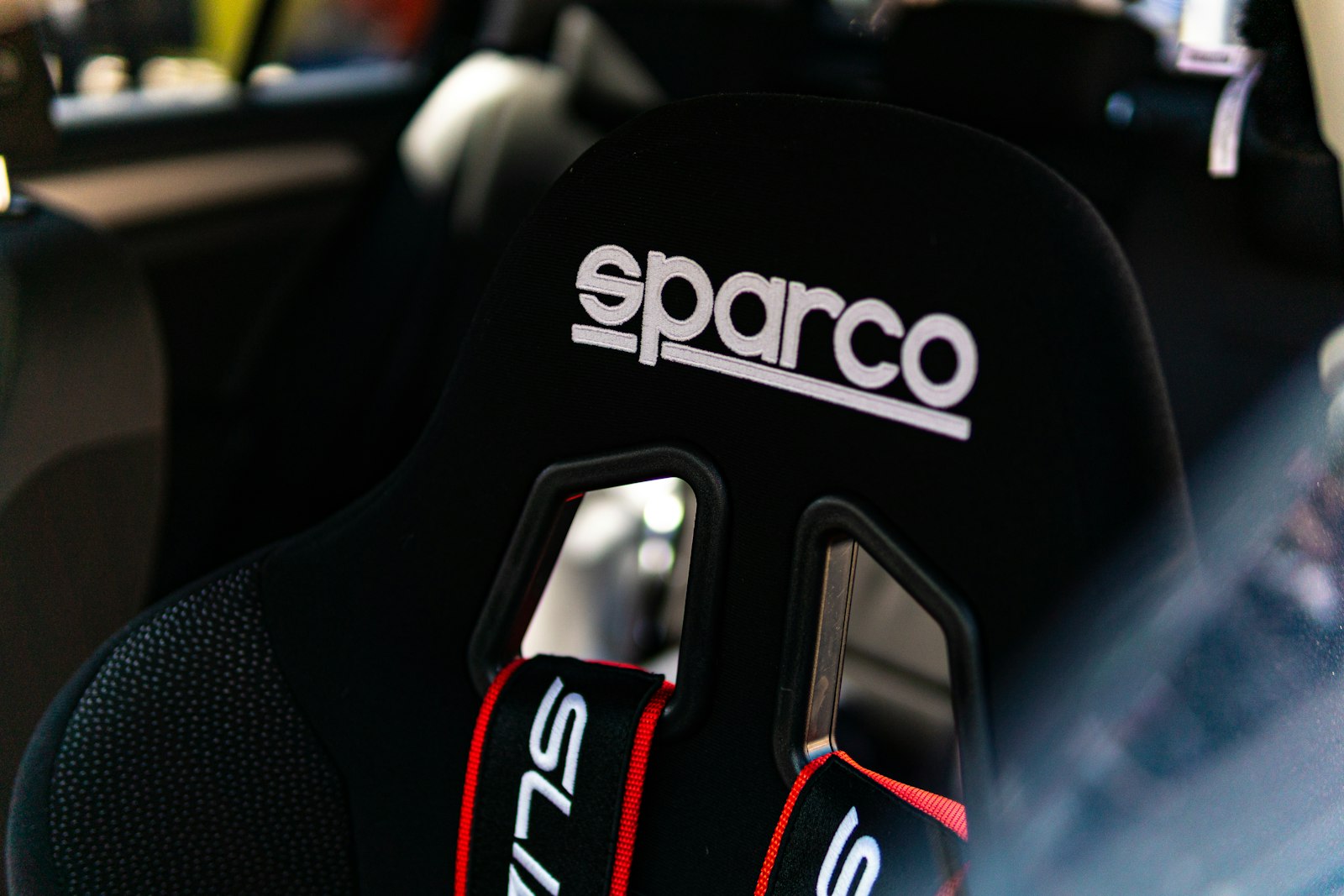 Photo by Nazariy Kovalov on Unsplash.
Do you even need a racing seat yet?
For a normal HPDE in a normal hardtop car, no. Your factory seat and factory belts are fine at most beginner events.
NASA's HPDE rules just say every seat must be "securely fastened to the structure of the car." A replacement seat has to be installed per the manufacturer's instructions. That's it.
The catch is what a racing seat drags in with it. NASA's HPDE section says stock belts "should not be worn with hard shell, fixed back racing seats." Those seats need a racing harness.
And a harness in a car with no roll bar is its own problem. We cover that trap in do you need a roll cage for a track day.
A racing seat is never a single purchase. It's a seat, a harness, and something solid behind your head.
Doing a few track days a year in your street car? Then a fixed-back seat is usually the wrong first buy. Spend on brake pads, fluid and coaching instead.
For wheel-to-wheel racing, it's not optional. NASA's racing rules say flatly: "A seat is required."
What makes a seat legal for racing?
Here's what NASA's 2026 Club Codes and Regulations (section 15.16) ask for:
- Solid design. No "tube and cloth" seats like most street cars use. The rulebook warns those are hard to brace and may fail tech.
- The right material. Seats made mostly of plastic, polymer, PVC or ABS are banned. Fiberglass, carbon fiber and Kevlar seats made for road racing are allowed.
- Installed per the maker. The install has to follow everything the seat manufacturer publishes.
- Head support on the right side. Every car except formula cars needs a right-side head restraint (15.17.9). A seat with a head bolster counts. So does a side head net with a quick release.
If you race SCCA instead, the GCR has its own seat section. Read that one. I'm quoting NASA here because NASA Rocky Mountain is where we race.
What does the FIA date on the label mean?
Most road racing seats carry an FIA homologation label. The two you'll see most are FIA 8855-1999 and the newer FIA 8855-2021.
This matters because of the seat back. NASA requires a seat back support behind the seat to keep it from folding in a crash (15.6.24). The exception is an FIA seat, mounted exactly the way its homologation says.
That exception has a clock on it:
| Seat standard | Brace-free for | After that |
|---|---|---|
| FIA 8855-1999 | 5 years from manufacture | Replace it, or add a seat back brace |
| FIA 8862-2009 or 8855-2021 | 10 years from manufacture | Replace it, or add a seat back brace |
| No FIA rating (many aluminum seats) | Never | Seat back brace required |
The 8855-2021 standard is worth knowing about. The FIA says it's much stronger than the 1999 version. It reaches about 60 percent of the strength of the top-tier 8862 seats. It also doubled the validity to 10 years.
One HPDE wrinkle. NASA lets expired FIA seats run in HPDE without a brace, if one wasn't required originally. So an old race seat can live on as a track day seat.
Buying used? Read the manufacture date before you read the price. A cheap seat with two years left is not cheap. Our racing gear expiration guide covers the dates on everything else you wear.
How do you know if a seat fits?
Start with the car, then your body.
Measure the car. Check the width between the tunnel and the door sill at the base. Then check up high, where head wings can hit the roof or the cage. Demon Tweeks' seat guide calls out both spots as the usual problems.
Measure your hips. Seat makers size by hip width. Compare your measurement to each seat's published chart.
Sit in it if you can. No chart beats ten minutes in the actual seat, ideally in your race suit. Then check three things:
- Shoulder slots. The harness should pass through the slots roughly level, then run down your chest. If your shoulders cover the slots, the fit is wrong.
- Side support. You want firm contact at your hips and ribs. If you can slide side to side, cornering loads will move you, and the harness can't stop that.
- Arm room. You still need full steering movement without the bolsters pinning your elbows.
Small gaps get filled with foam or an insert. Big gaps mean the wrong seat. Once it's in, our racing driving position guide covers dialing in pedal and wheel distance around it.
How does a racing seat get mounted?
Side mounts are the standard. They bolt to the seat's sides and give you a few hole positions for angle. Most racing seats are built for them.
Demon Tweeks puts two warnings plainly. Don't drill mounting holes in a seat that wasn't made for bottom mounting. And if two drivers share the car, use only double-locking sliders.
NASA's rules (15.16.2) want the seat mounted to a steel floor pan with reinforcement, or through frame members. Cars without a steel floor need a reinforcement structure at least 0.090 inches thick, tied into the chassis or cage. Big fender washers and solid fabricated mounts are recommended.
Two harness rules ride along with the seat:
- Shoulder belt angle. NASA wants shoulder belts mounted level with your shoulders, or up to 20 degrees below.
- Seat holes aren't harness guides. You can't route belts through the seat to fix a bad angle. Only a harness bar, the cage or the chassis count.
NASA also recommends a 6-point harness for upright seats, up to 30 degrees of recline. Laid-back seats get a 7-point.
What does a first racing seat cost?
An entry-level FIA seat plus its side mounts runs a few hundred dollars each. Here's what I found in October 2026:
- Seat. The 24 Hours of Lemons store lists a Sparco Sprint, rated FIA 8855-1999, at $500. Every color showed sold out, so availability moves.
- Side mounts. Discovery Parts lists Sparco, Sabelt and OMP side mounts from $140 to $179 a pair.
So call it roughly $650 to $700 before the floor mount, the harness, and any fabrication. The FIA's own target for an 8855-2021 seat was around 500 euros. Carbon shells and more head containment push the price up from there.
That's a real number for a part you'll replace every 5 or 10 years. It's one more reason to know whether you need one before you buy.
The short version
- Doing HPDE in a street car? Keep the factory seat for now.
- Going racing? Buy for fit first, label date second, brand last.
- Mount it the way the maker says, and plan the harness and brace with it.
- Check your rulebook, then ask your region's tech chief before you drill anything.
Getting the car through tech is half the battle on a first race weekend. The other half is showing up with everything else. That's why we built the free Race Day Ready Pack, with the checklists we use at LeadFoot Racing.
Sources: NASA Club Codes and Regulations, 2026.3 edition, sections 11.4.8, 11.4.12, 15.5, 15.6.24, 15.16 and 15.17.9, FIA: New high-strength, cost-effective seat standard, Demon Tweeks: How to choose a motorsport seat, 24 Hours of Lemons store: Sparco Sprint racing seat, Discovery Parts: side mount brackets. Rules and prices checked October 2026. Rules change by club, class and year; your current rulebook and your region's chief of tech are always the authority.
Do you believe?