
Most people book a dyno to chase horsepower.
In club racing, the more common reason is paperwork. If you want to run NASA Time Trial or Super Touring in a power-to-weight class, a signed dyno sheet is not optional. It's the document that tells the club which class you belong in.
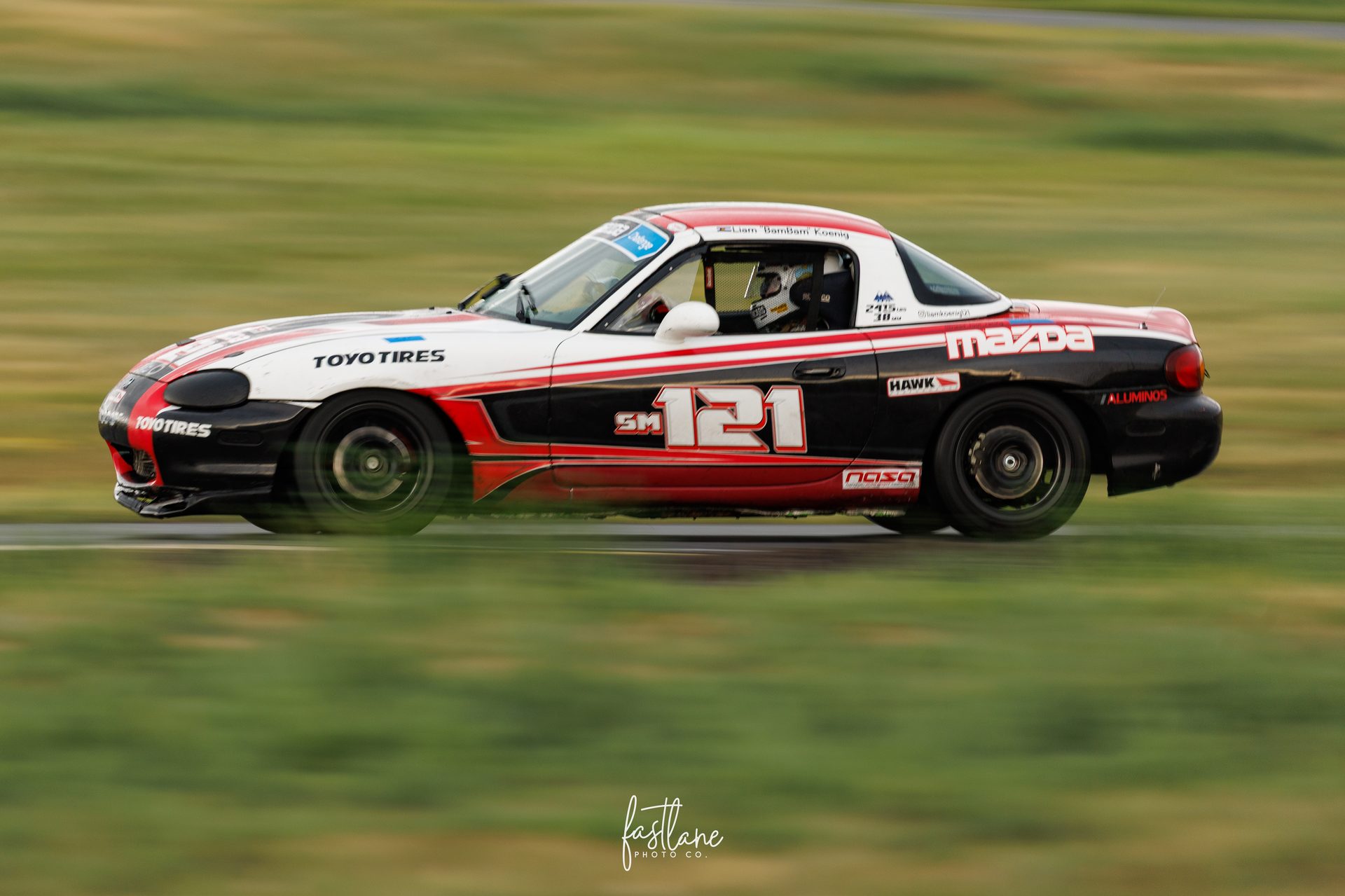 The #121 in full song down the straight at High Plains Raceway, NASA August weekend. Whatever the dyno said, this is where it gets settled.
What a dyno session actually costs
There are three different things people call "a dyno day," and they don't cost the same.
A baseline pull is measurement only. Nobody touches your tune. You get numbers and a printout. A tuning hour is somebody actively changing your map while the car is strapped down. A certification run is a baseline set done to a sanctioning body's specific procedure, with a form signed by the operator.
Here are published rates from two Colorado shops, checked in September 2026.
| What you're buying | Published rate | What you get |
|---|---|---|
| Baseline, 3 power pulls | $160 at 5250 Performance (Longmont) | HP, torque, air-fuel ratio, boost monitoring |
| Baseline dyno test | $190 at Finish Line Automotive (Denver area) | Rear-wheel HP, torque, AFR, printouts, max one hour |
| NASA/SCCA dyno certification | $190 at Finish Line Automotive | The runs plus the signed certification |
| Dyno tuning | $250 per hour at Finish Line Automotive | Carb or EFI tuning while you're on the rollers |
| Dyno rental with an operator | $220 for the first two hours, then $170/hour at 5250 Performance | The machine and a body to run it; you or your tuner do the work |
Those are two shops in one state. Rates move with region and equipment, so call before you budget. But the shape holds: a measurement is a couple hundred dollars, and a tune is an afternoon of shop labor.
Read the fine print too. 5250 runs the clock from the moment your car enters the dyno until it leaves the premises, and lists a cleanup fee up to $350 if your car dumps fluid on their equipment. If you're running leaded fuel or methanol, expect to pay for an oxygen sensor.
Against a season where tires alone eat four figures a weekend, a $190 certification is one of the cheaper line items you'll hit. It's just an easy one to forget until entry closes.
Why the dyno is paperwork, not bragging rights
NASA's Time Trial and Super Touring classes are built on a number the rulebook calls the Adjusted Weight/HP Ratio. Pounds per horsepower. Higher number, slower class.
Rule 7.1 of the 2026 TT rules is blunt about it. Every TT competitor except TTU, TTGT, and TTEV must submit a current-year Car Classification Form and a certified dyno report to the Regional TT Director before any lap times count toward competition. No sheet, no score.
The class ladder works like this:
- TT1 — 6:1 or higher
- TT2 — 8:1
- TT3 — 10:1
- TT4 — 12:1
- TT5 and TT6 continue up from there. NASA Southeast's published classification overview lists 14.5:1 and 19:1, though figures have shifted between rules years, so confirm against the current Super Touring rules before you file.
Then modification factors adjust that ratio up or down based on tires, suspension design, aero, cage construction, throttle type, and more.
NASA Southeast publishes a worked example using a 1999 Spec Miata, and it's the clearest illustration I've seen. Dyno'd average of 125 horsepower. Modification factors totaling positive 1.30. That moves the TT6 requirement from 19.0 to 20.3, which means that car could drop to 2,230 pounds and still be legal in class.
That's the real function of the dyno sheet. It isn't a trophy. It's an input to a formula that decides who you race against.
The rules that decide whether your sheet counts
This is where people waste money. You pay for pulls, then find out the club won't take them.
NASA's ST/TT Official Dyno Certification Form spells out the procedure. The ones that catch people:
- It has to be a commercial facility open to the public. The operator cannot be you, the car's owner, or a crew member, and has to work for the business. Your buddy's shop dyno on a Sunday doesn't count.
- Front- and rear-wheel-drive cars must run on a Dynojet. All-wheel-drive can use a Dynojet, Mustang, Dyno Dynamics, or Dynapack, but Mustang and Dyno Dynamics numbers get multiplied by 1.1 for classing.
- RPM has to come from an inductive pickup or direct sensor — not the OBD port, not the tach.
- At least three separate, reproducible pulls per power configuration, graphed together on one sheet.
- SAE J1349 Rev JUN 90 correction, smoothing factor five. Both, specifically.
- The graph has to show power falling off for 1,500 rpm past peak, or the car has to hit the rev limiter.
- Hood open, cooling fan in front of the radiator, normal operating temperature, tires at 28 psi minimum, tested in the gear closest to 1:1.
- The printout has to carry date and time, owner name, car number, year/make/model, shop name and phone, and the operator's name.
Say two sentences when you book: "Three pulls on one sheet, SAE J1349 correction, smoothing factor five." That's the difference between a valid submission and $190 you spend twice.
Does 5,000 feet change your number?
Yes on the drum. No on the form.
Correction factors exist exactly for this. SAE J1349 normalizes what the machine measured back to standard conditions using air pressure and temperature. We walked through a published example in our piece on horsepower loss at altitude: an engine that read 425 horsepower on a Denver-area dyno corrected out to roughly 495. Same engine, 70 horsepower of arithmetic.
So a Colorado racer doesn't get classed into a slower group for living at altitude. The corrected number is the number.
It cuts the other way too. You don't get a break for racing thin air. Your class is set by corrected power, and everybody in the field at High Plains Raceway is giving up the same percentage on race day anyway.
One practical warning. Dyno software offers more than one correction standard, and the shop's default may not be the one NASA asks for. Ask which correction was applied before you leave, not after.
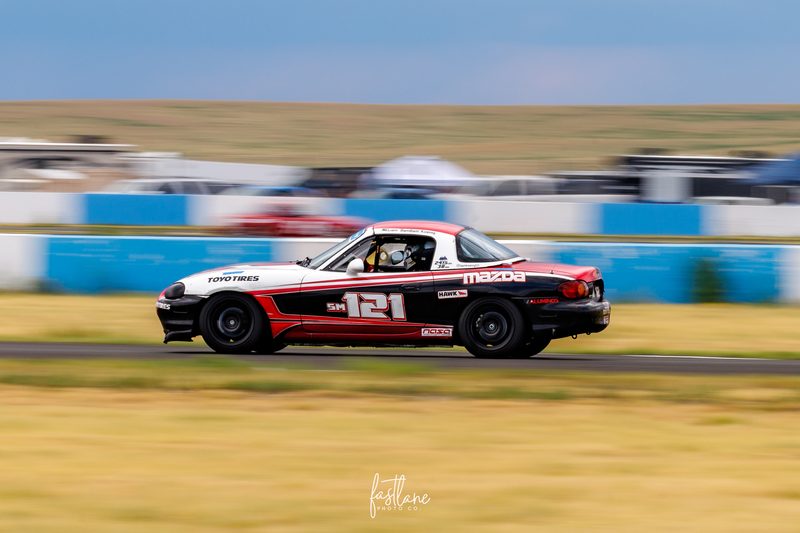 High Plains Raceway sits above 5,000 feet. The dyno math corrects for it. The engine doesn't.
SCCA went the other direction entirely
SCCA Time Trials doesn't class by dyno at all.
Their ClassMyCar process is rules-based. You pick a category — Sport, Tuner, Max, or Unlimited — compare your car against the written modification allowances, and land in a numbered class from 1 to 6. Displacement, weight minimums, treadwear ratings, permitted parts. The site's summary of the whole philosophy: "if it doesn't say you CAN, you CAN'T."
No dyno line item. No certification form. Zero dollars to get classed.
Both approaches are defensible, and it's worth knowing the trade. NASA measures your actual car, which means almost anything fits somewhere. SCCA costs nothing to enter but requires your build to fit a box somebody already wrote.
If you're budget-first, that difference is real money.
The part that bites people
The numbers on your classification form are the basis for post-competition impound.
NASA Southeast puts it plainly: if they dyno your car in impound and it makes more power than your form declares, you're disqualified from that full day of competition. Weight works the same way. Come in under the Minimum Competition Weight on your form and you lose every lap time for the entire event day, and under rule 7.4 you can't switch classes until the next day.
The rulebook's own advice is to build in margin. Optimize your declared weight and average horsepower so your adjusted ratio sits at the class limit with as much room as possible for dyno variance. Don't shave it to zero and hope.
And TT officials don't grade on a curve. The rules state that penalties for non-compliance "will be harsh, and may include disqualification and expulsion from further NASA TT competition with a single infraction."
For a lot of drivers, the cheapest answer is not needing a dyno at all. Spec classes are classed by rulebook, not by measurement — which is one reason our own rental Spec Miatas never see a certification form. Everybody has the same restrictor, the same parts list, and the same math.
If you'd rather spend your money on seat time than on classing paperwork, that's what our arrive-and-drive program is built around. Show up, drive a prepped car, let somebody else own the forms.
Sources: NASA ST/TT Official Dyno Certification Form, NASA Time Trial Official 2026 National Rules, NASA Southeast TT Vehicle Classification, SCCA Time Trials ClassMyCar, Finish Line Automotive & Performance dyno services, 5250 Performance dyno tuning. Shop rates are published listings verified September 2026 and change without notice. Rules quoted from the 2026 TT rulebook version 23.1 and the rev 3/22 certification form — always confirm class ratios against the current Super Touring rules before filing.
Do you believe?