
There's no birthday when a racing career changes hands. Nobody gives your kid the keys at 14 or 16 and says, "It's yours now."
The handoff happens one job at a time. The parents who get it right plan it. The ones who don't usually find out when their kid stops wanting to go.
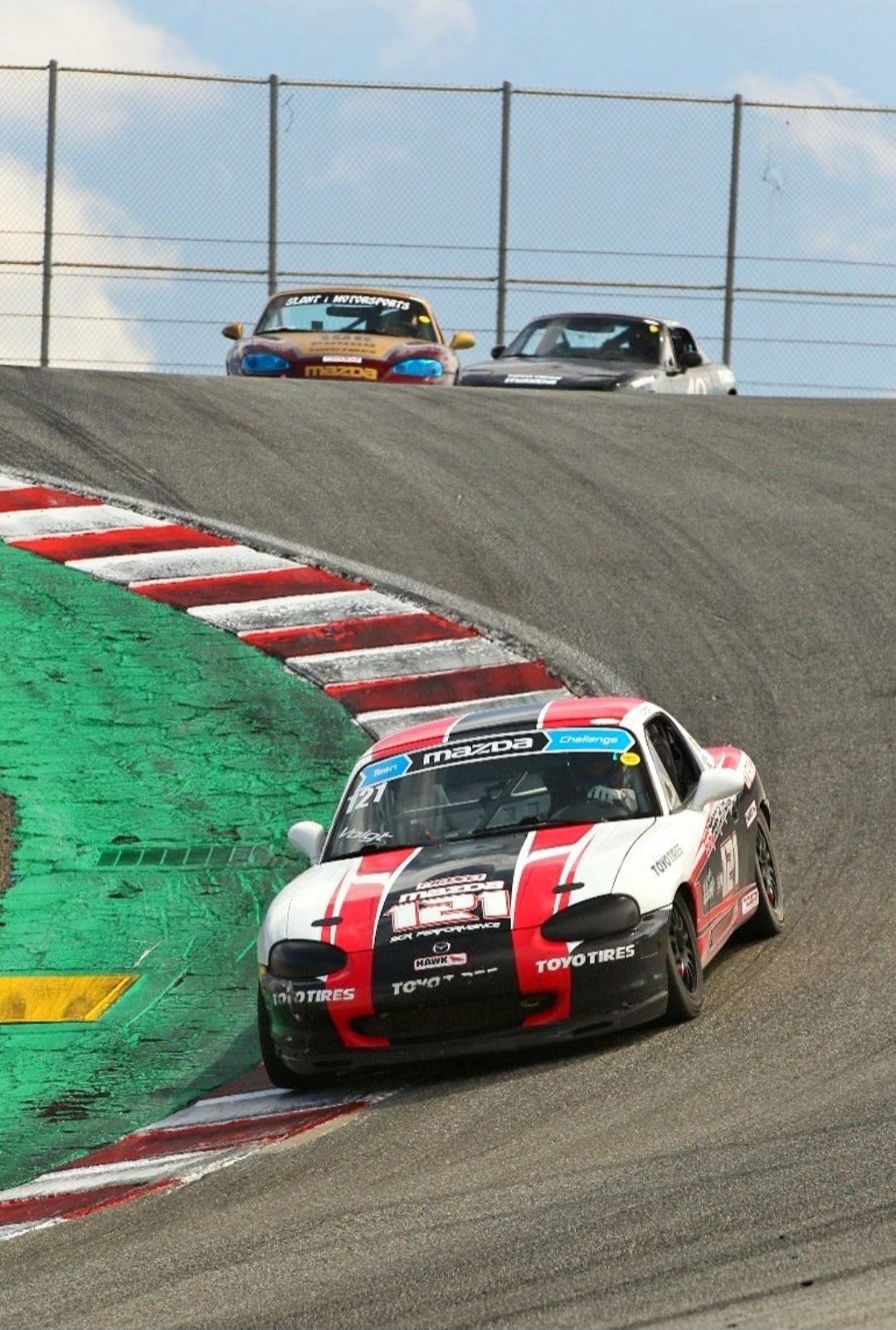 Our #121 through the Corkscrew at Laguna Seca. Once the visor comes down, the driver is on their own. The rest of the career can work that way too.
What the research says about pulling back
No study looks at racing families on this exact question. Research on sport parents in general points one way.
A 2024 systematic review in Frontiers in Psychology pulled together 29 studies covering more than 9,000 young athletes. The authors found that moderate parental involvement works best. Not absent. Not running everything.
The same review found that autonomy-supportive parenting, meaning you give real choices and explain the why, was linked to better motivation. Parental pressure was strongly linked to "controlled" motivation. That's the kind where a kid races to avoid letting you down, not because they love it.
In one study the review cites, parent autonomy support predicted a young athlete's motivation better than coach autonomy support did. You carry more weight than the coach on this one.
Hand it over by job, not by age
Sport researcher Jean Côté studied the families of elite young athletes in 1999. He described three phases: the sampling years, the specializing years, and the investment years. The family dynamics change in each one.
Racing works the same way. Here's the order I'd hand jobs over, from easiest to hardest:
- The gear bag. Your kid packs it, checks it, and owns it if something gets left at home. Our karting parent year one post covers this as the first real job to give away.
- The notes. After every session, they write down what the car did and what they'd change. Not you.
- The coach debrief. They talk to the coach directly. You stand back and listen. If you're still translating, they aren't ready for the next step.
- The sponsor outreach. They find the businesses, write the emails, and follow up.
- The plan. Which races, which goals, which budget. They bring a proposal to the kitchen table. You still have the final say.
Each step only moves once the one before it sticks. A 13-year-old might own the first two. A 17-year-old might be pitching sponsors and building next year's schedule.
Signs they're ready for the next job
Hand over the next job when you see these:
- They ask before you tell. A kid who asks "when's the next test day?" is pulling, not being pushed.
- They fix their own small mistakes. Forgot their gloves once, never again. That's ownership.
- They can take bad news from someone else. A coach says they braked too early. They ask how to fix it instead of looking at you.
- They talk about the next race, not the last one. That shift tells you the drive is theirs.
If none of those are showing up, that's not a failure. Some kids love driving and don't want the rest. That's fine too. Just don't force a career on a kid who wants a hobby.
The jobs that stay yours
Some things don't move until your kid turns 18, no matter how ready they are.
The legal side. At NASA events, minors need a parent or guardian at the track to sign the minor waiver. A NASA SoCal event page we checked also says the parent has to stay for the whole time the minor is participating. Other series and tracks have their own rules, so read each event's supplemental regs.
The contracts. A minor's signature on a sponsor deal doesn't carry much weight on its own. We walked through who actually signs in who signs a minor's racing sponsorship.
The safety call. You can hand over the schedule. You don't hand over the final word on whether a car, a track, or a weekend is safe.
Being Mom or Dad. The car ride home is still yours. The more jobs you give away, the more that one matters.
Where the sponsor job fits
Sponsor outreach is the job where most families freeze. Handing it over feels risky. A structured plan helps. It gives your kid steps to follow, so you check progress instead of writing emails. That's why we built the Sponsorship Accelerator. It's a 30-day plan that gets a racer from "I should find a sponsor" to sending their first pitch, for $27. Let your kid run it. You hold them to the deadlines.
Start this week
Pick one job off the list and give it away for good. Not "help me with it." Give it away.
Is your kid between 13 and 25? Do they want racing to be a career, not just a weekend? Kart to Car is built for that next step. It's coaching, sim training, and sponsor coaching for young drivers moving into full-size race cars. They do the driving. We help them build the rest.
The goal was never to run their career forever. It's to raise a driver who can run it without you.
Do you believe?
Sources: Gao et al., "The role of parents in the motivation of young athletes: a systematic review," Frontiers in Psychology, 2024, Côté, "The Influence of the Family in the Development of Talent in Sport," The Sport Psychologist, 1999, NASA SoCal event page, minor participation rules (cites NASA CCR 3.5). The review covers youth sport in general, not racing; no racing-specific study on this question was found. NASA minor rules were checked on a 2026 event page; confirm the current rules for your event. Verified as of November 2026. Anything else here is based on these sources plus my own racing experience.