
"We should do a giveaway together."
It's the sentence every racer wants to hear from a sponsor. It also kills more deals than a bad pitch does, because the racer says yes, sends over a vague idea, and then the brand's marketing person asks four questions nobody prepared for.
Then it goes quiet. Not because they lost interest. Because you handed them homework.
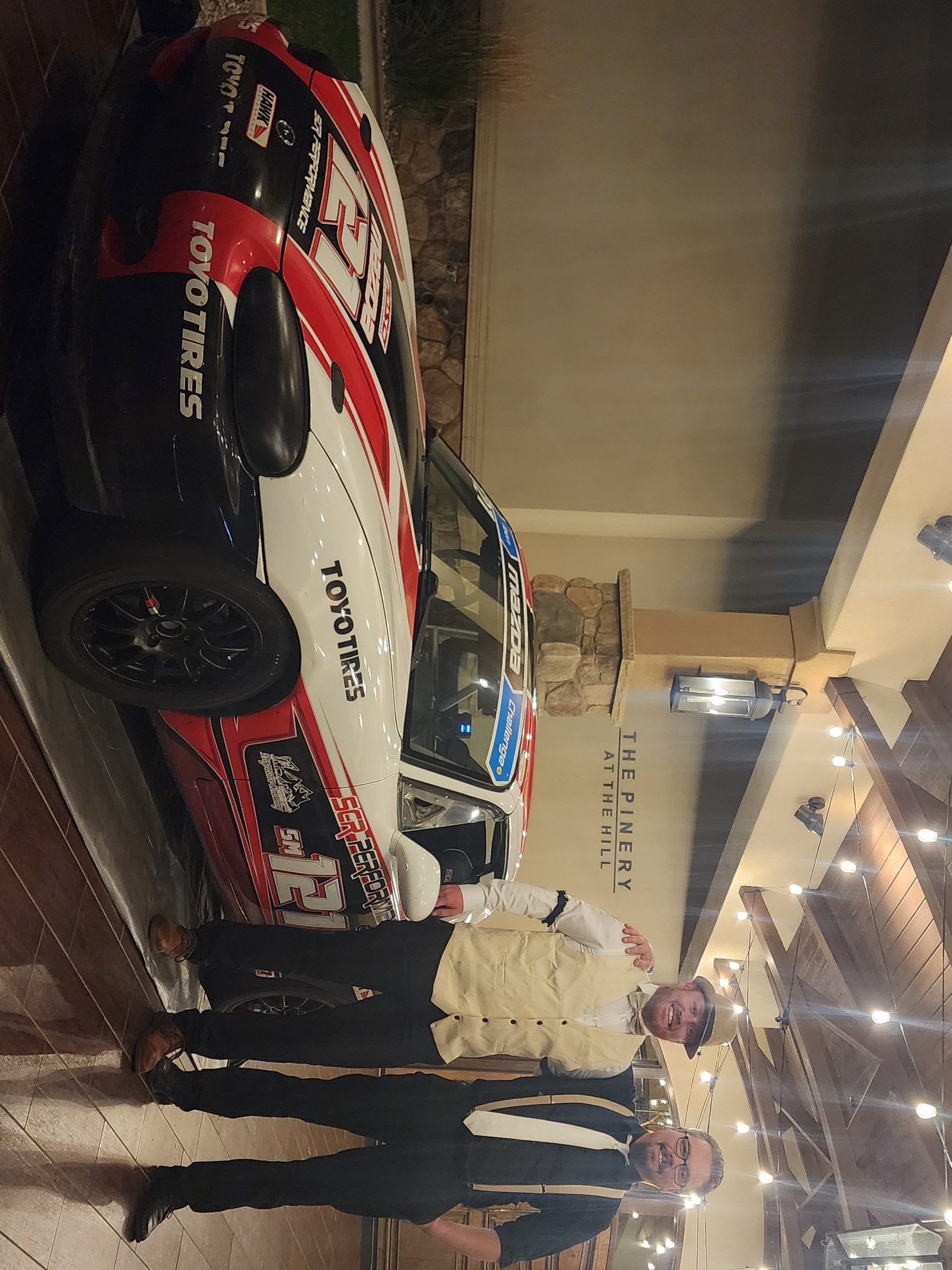 Our sim rig on display at a Colorado Springs community event. A race car or a sim rig in a lobby is the whole reason a local business says yes to a giveaway.
The one line that turns a giveaway into a crime
Start here, because everything else depends on it.
A promotion becomes an illegal lottery when three things show up at once: a prize, selection by chance, and consideration — meaning people had to buy something or pay to get in. That's the tripwire, and private companies can't run lotteries.
So you kill one of the three legs. Two clean ways:
- Sweepstakes. Winner picked at random, but entry is free. If there's any paid path in, you must offer a genuinely free alternate method of entry that's just as easy and doesn't give worse odds.
- Contest. Winner picked on skill against judging criteria you publish in advance. Because it's merit, not chance, a purchase requirement is allowed.
Most racer-and-local-business promotions should be sweepstakes. Free to enter, random draw, done.
Here's what matters for your pitch: a sponsor's marketing team already knows this. If your one-page giveaway proposal says "free to enter, random draw, official rules attached," you just cleared the first thing their legal person would have flagged. If it doesn't, you look like a liability.
The $5,000 number that decides how complicated your life gets
This one is worth memorizing.
If the total value of all prizes exceeds $5,000, New York and Florida want you to register and bond the promotion. New York wants the filing with the Department of State at least 30 days before you start, with a $100 fee and a surety bond equal to the total prize value, plus a certified winners list afterward. Florida files with the Department of Agriculture and Consumer Services at least 7 days out, also $100, also bonded.
The threshold is cumulative. Ten $600 prizes is $6,000 and it counts, even though no single prize is close.
Design your prize under $5,000 total and a whole layer of cost, paperwork, and lead time disappears.
That is a real decision, not a technicality. It's the difference between a promotion you can launch in three weeks and one that needs a lawyer and a bond before you print a single sign.
There's a tax side too. Brandmovers' 2026 compliance guide notes the federal reporting threshold for prizes moved up to $2,000 for prizes awarded in 2026, from the old $600. Know where your prize lands and tell the winner up front. None of this is legal or tax advice — for anything real, have a professional in your state look at it.
The four questions their marketing team will actually ask
Assume the person on the other end has run promotions before and has a boss. These are the questions that decide whether it happens.
1. Who's paying for the prize, and what's it worth? Say it plainly. "We supply the rig, you supply the gift cards" is an answer. "We'll figure it out" is not.
2. Where do the official rules live? They need a stable URL with eligibility, dates, entry methods, odds, prize description and value, winner selection and notification, and the sponsor's legal name. Build the rules page before you pitch. It costs you an afternoon and it makes you look like a partner instead of a project.
3. What's the entry mechanic — and is it allowed? This is where racers get burned. You can't require someone to share a promotion to their personal timeline or tag friends as the entry mechanic on Meta's platforms, and you have to state that Meta isn't involved in the promotion. Comment, follow, and hashtag entries are generally fine. And under the FTC's Endorsement Guides, if people are posting to enter, their posts need a clear disclosure — buried at the bottom of a hashtag wall doesn't count.
4. What do we get out of it, in numbers? Not "exposure." Signups attributed to their location. Foot traffic. A named report on a named date.
That last one is the whole ballgame, and it's the same muscle as pricing any other sponsorship asset. The Funded Season Kit ships with the two spreadsheets we actually use for this — a sponsor tracker and an ROI calculator — because "here's the number we'll report back to you" is what turns a fun idea into a funded one.
The part racers forget: who owns the emails
A giveaway's real output isn't the prize. It's a list.
Decide this before you pitch, and put it in the proposal in one sentence. Who collects the emails, who gets a copy, and what each side is allowed to send. If entrants' data goes to a partner, the entry form has to say so — a consent line the entrant can actually see, not a link buried in the rules.
We run ours the honest way: the entry form discloses which host business is credited, and the sharing language is tied to that. It's more work. It also means nobody gets a surprise email from a company they never heard of, which is exactly the kind of thing that ends a partnership in year one.
If you're building this with a neighborhood business rather than a national brand, start with the free Local-Business Sponsorship Workbook — it walks the prospecting and pitch side, and pairs with our post on finding local sponsors.
What we're building right now, as a live example
We're mid-build on a sim rig giveaway here in Colorado Springs, so this isn't theory for me. No hosts are signed yet and it hasn't run, so I've got no results to sell you — but the plan is real, and the design decisions map straight onto everything above.
- Eight weeks, eight host businesses. The rig sits in one local business's lobby per week. Tire shops and auto parts stores lead the list, because a 45-minute install means a captive lobby.
- Prize built to roughly $1,650 total. Cockpit, wheel and pedals, shifter, gear, merch. Deliberately, comfortably under $5,000.
- Email signup is the only required action. Everything else — follows, referrals — is optional bonus entries. Free to enter, random draw.
- A unique QR code per host. That's the whole point. Every host gets a report showing signups credited to their location, not a shrug about brand awareness.
- Never two direct competitors. One tire brand for the tour, not two. You don't ask two businesses to fight over the same customer.
That last rule isn't legal, it's just respect. And it's the sort of thing a marketing manager notices immediately.
Every one of those bullets started as a line in a tracker, which is exactly how the Funded Season Kit teaches you to run a partner — assets, deliverables, report dates, all in one sheet instead of in your head at 11pm.
If a race car or a rig sitting in a business's lobby sounds like your kind of pitch, we broke that down further in how to use a race car for brand activation events.
Bring the plan, not the idea
A giveaway is the easiest upgrade you can offer a sponsor, because it's the one activation where a small local business gets something they can count.
But nobody hands a racer a promotions budget for an idea. They hand it over for a plan — legal structure, prize under the threshold, a rules page, a compliant entry mechanic, and a report with their name on it.
If you want the whole system for building that kind of package and pricing it, The Funded Season Kit is $197 — eleven modules, both spreadsheets, built to fund a season rather than land one lucky sticker. It's the version of this I wish I'd had when I was cold-calling businesses with nothing but enthusiasm.
Bring the plan. Watch how differently they answer.
Do you believe?
Sources: Brandmovers — 2026 Sweepstakes & Promotions Compliance Guide, Klein Moynihan Turco — Sweepstakes Registration and Bonding Requirements, The Social Media Law Firm — Florida Sweepstakes Registration, Woobox — Instagram Giveaway Rules and Compliance, FTC — Endorsement Guides: What People Are Asking. Promotion-law thresholds verified against these sources as of August 2026. Prize values and campaign details are from LFR's own in-progress giveaway plan. This post is not legal or tax advice — have a professional in your state review anything you actually run.