
Three races. That's the whole year.
Not because you quit, and not because you're not serious. Because work, or school, or money, or a tow rig that only makes it two hours from home.
Then you go to write the sponsorship email and freeze. Everybody else's proposal says "full season." Yours says three weekends. So you either lie about it, apologize for it, or never hit send.
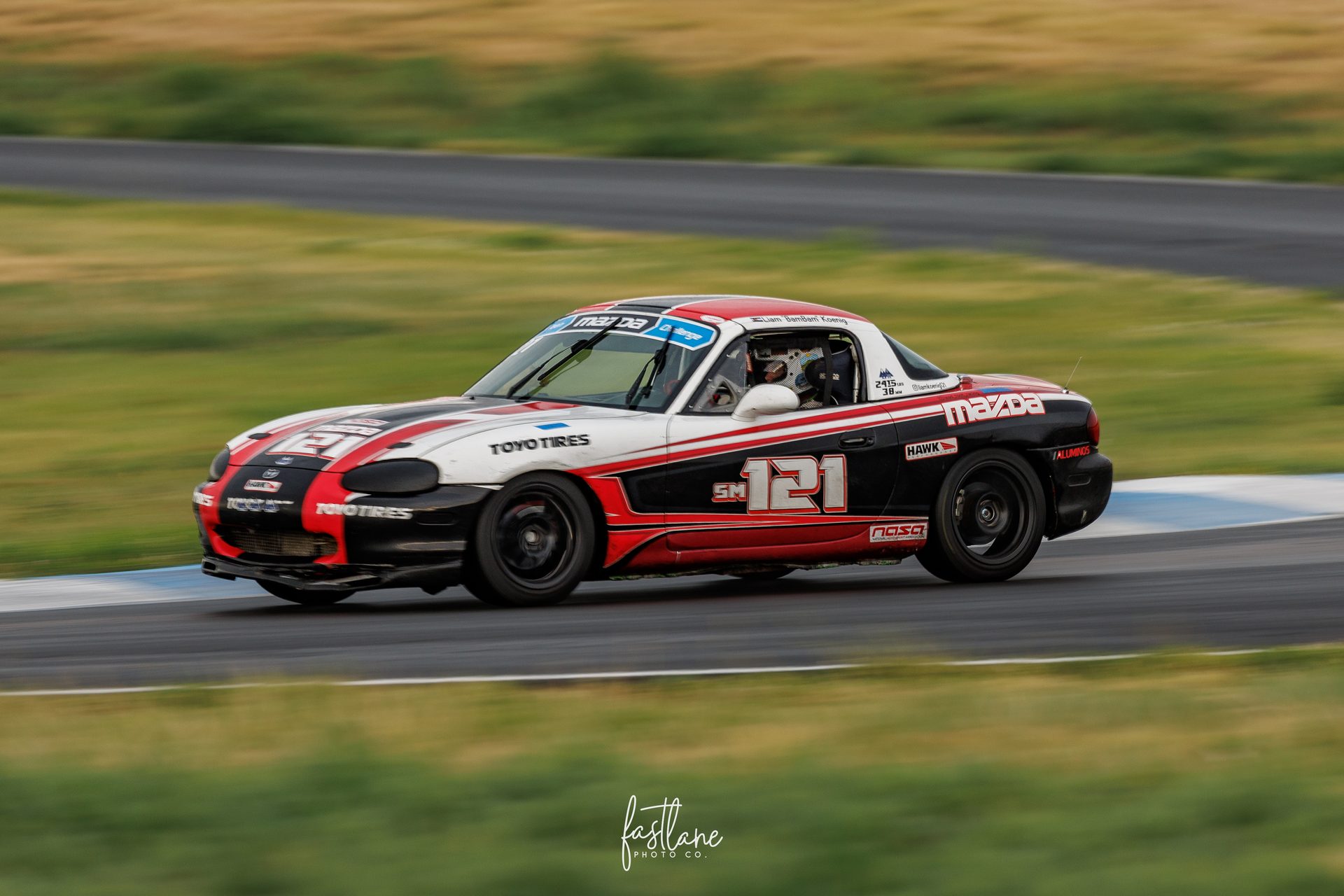 The #121 on corner exit at the NASA High Plains Raceway weekend, August 2026.
A short season is a different product, not a worse one
Here's the thing nobody tells grassroots racers. Single-event and partial-season sponsorship is a normal, priced, heavily-transacted product at every level of this sport. It's not the consolation prize.
Look at how it's sold at the top. RTR Sports publishes NASCAR ranges for 2026: a Cup Series primary sponsorship runs roughly $150,000 to $500,000 for one race, while a full season with a top team runs $12 million to $35 million.
Do the arithmetic on a 36-race Cup season. A mid-tier season deal works out to something like $139,000 to $333,000 per race. And a single race at that level sells for $150,000 to $300,000.
Buying one race doesn't come with a per-race discount. It lands right in the same band as buying the whole year.
That's the mental shift. Volume gets a discount in most businesses. In sponsorship, volume mostly gets you continuity — and brands pay separately for that. The per-event unit holds its price.
If you want the pitch language that treats a short calendar as a real package instead of an apology, it's built into The First Sponsor System — the $67 kit of the actual working documents we use to fund our own cars.
What you sell when you can't sell season-long visibility
You can't offer twelve months of car livery. Fine. Offer the things a short season is genuinely better at.
Concentration. Marketing people know this pattern as flighting — spending in a heavy burst instead of spreading thin all year. Media planners recommend it exactly when a budget can't sustain year-round presence, because a high-frequency burst in a short window can create stronger, faster recall than a thin campaign stretched across twelve months. Three races in nine weeks is a flight. Sell it like one.
Activation runway. Sponsorship guidance commonly puts a brand's activation budget at 50% to 100% of the sponsorship fee on top of the fee itself. A brand with three dates instead of thirty can actually show up at all three. They can staff it, bring product, run the tent. That is worth more to them than a logo at twenty events they never visit.
Content volume. Your season is short. Your content year isn't. Three weekends produce photos, in-car footage, results, and stories you can post from January to December.
Depth per event. One race you actually promote beats six you silently attend. Pick a home track, invite their customers, do the appearance, run the giveaway.
None of that requires a long calendar. All of it requires you to say what you'll do in writing.
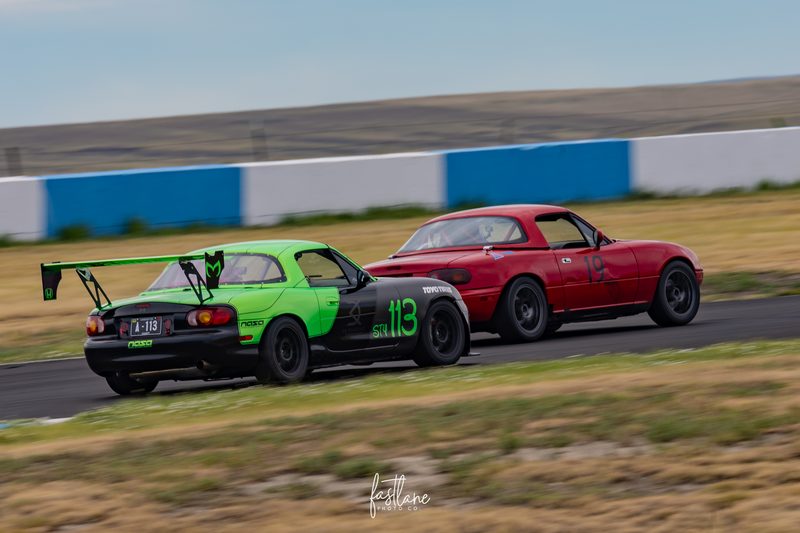 The #19 working traffic at High Plains Raceway, August 2026.
Price it per event and let the total be the total
The simplest way to price a three-race package is to stop pricing a season at all.
Build one event as a unit: what the sponsor gets at that race, what you'll produce from it, what you'll report afterward. Then multiply. Three times a defensible number is a defensible number.
Start with your real floor. A competitive DIY Spec Miata weekend runs roughly $2,000 to $3,500 once you count a set of tires around $1,200, an entry near $500, fuel, pads, and fluids — assuming you do your own wrenching. Three of those is $6,000 to $10,500 of actual season cost.
That number isn't your price. It's the thing you can't charge less than and still be honest about what you're building.
For what's above the floor, look at what small sponsorships actually clear. Published 2026 event-sponsorship benchmarks put entry awareness tiers around $1,000 to $2,500 and engagement tiers around $2,500 to $5,000. Those are event-industry numbers, not motorsports, but they're a sane reality check on what a local business says yes to without a committee.
The full valuation method — assets, tiers, the whole build — lives in how to price racing sponsorship. I won't restate it here.
The dead months are where short seasons lose the deal
Here's the honest risk, and you should name it before the sponsor does.
Media research is blunt about the downside of flighting: advertising's effect is short-lived and gets forgotten without reinforcement, and a dark period is a period of zero visibility. Your three-race calendar has a lot of dark.
So you fill it. Not with noise — with proof.
- A written recap inside a week of each event, with photos and numbers
- One piece of content per month between races using footage you already have
- An off-season report that shows the brand what its money produced
That last one matters more than people think. Event-sponsorship guidance is direct about it: packages without a measurement component are hard to renew, because the sponsor can't defend the spend internally. If you go dark and silent, you're not getting year two.
The cadence I use between events is spelled out in what to send a sponsor mid-season. Build that into the proposal, not into your good intentions. The report templates themselves ship inside The First Sponsor System, so you're filling in a document instead of inventing one at 11pm.
Say "three races" in the first email
Don't bury it. Don't write "2026 season" and hope they don't count the dates.
Put the three dates in the opening paragraph with the track names. A brand that can't work with three dates will tell you fast, and that's a gift — you just got an hour back. A brand that can work with three dates now trusts the rest of your numbers, because you led with the least flattering one.
Two things kill short-season pitches, and neither is the length of the season:
- Apologizing for it. "Only three races" and "a focused three-event program" describe the same calendar. One of them gets a reply.
- Discounting on instinct. Cutting your price because your season is short teaches the sponsor that your events are cheap. That price is the anchor for every renewal conversation you'll ever have with them.
If you've already got a pitch written and you're quietly unsure it survives a short calendar, send it through The Pitch Inspection — $39, and you get it back marked up in writing by the team that pitches sponsors for its own race cars.
Three races is enough. Plenty of racers have funded a car on less, and every full-season program I know started as somebody's short season. What kills the deal is treating the short calendar like a flaw instead of a package.
Build the package, price it per event, and send it. The First Sponsor System has the templates, the outreach sequences, and the proposal structure to do it this week instead of next season — $67, yours to keep.
Sources: RTR Sports — NASCAR sponsorship costs and packages 2026, SuperHub — motorsport sponsorship costs, real prices for 2026, Journalism University — media scheduling strategies: pulse and flighting, AnyRoad — event sponsorship packages, tiers, pricing and ROI 2026. Per-race arithmetic is my own, using RTR Sports' published ranges across a 36-race Cup season. Racing cost figures are LFR's own 2026 budget lines. Event-industry tier ranges are labeled as such and are not motorsports figures.
Do you believe?