
The text comes in on a Tuesday. "Hey — are you running Pueblo in October? Our regional guy wants to bring some customers out."
Nice question. Easy yes. Then next season the same sponsor asks you to skip a round you'd already paid for, because it's four hours outside their sales territory.
That's when you find out whose calendar it actually is.
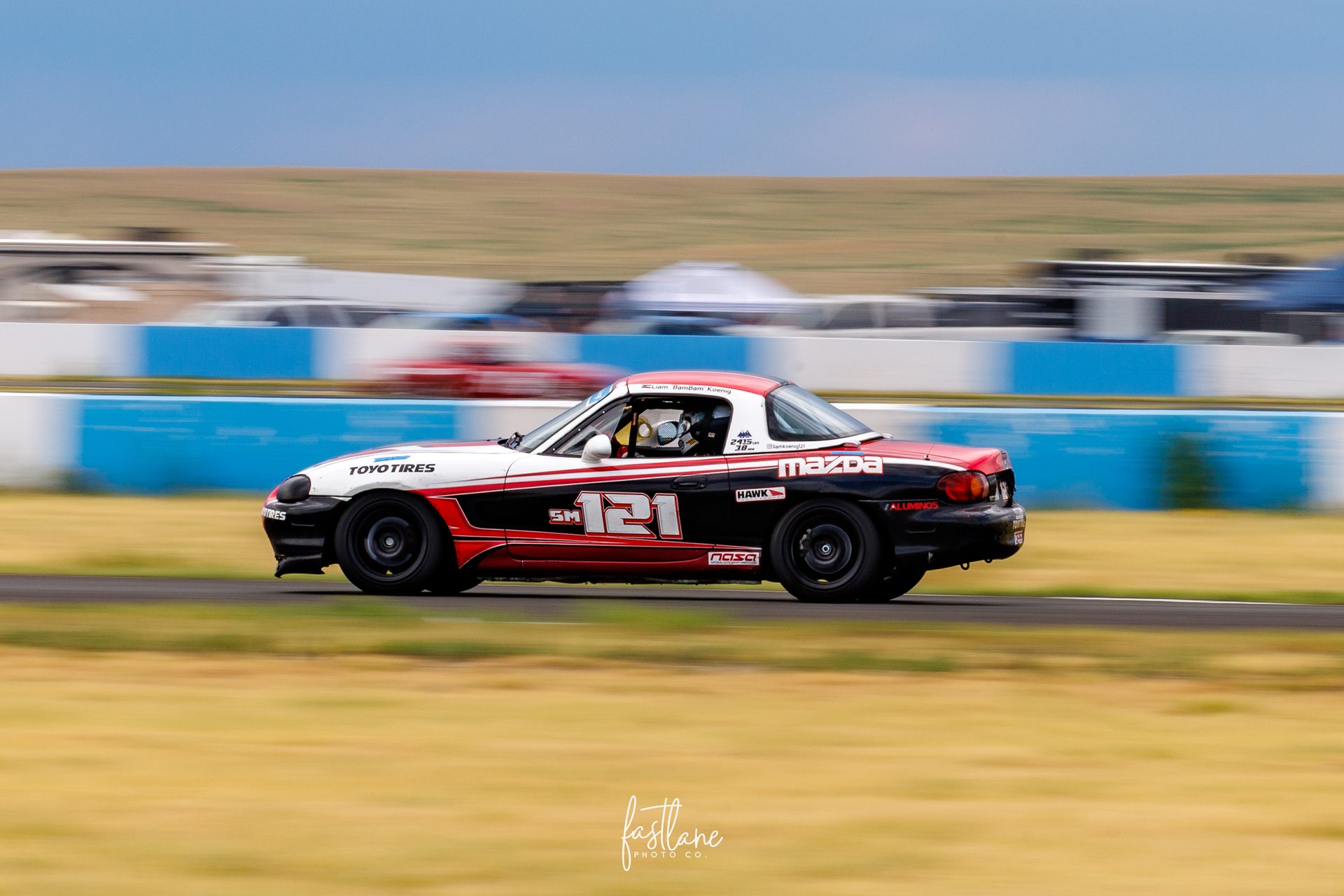 The #121 at our NASA High Plains Raceway weekend, August 2026. Six weekends on our schedule. Somebody's money is riding on all of them.
First: a sponsor asking about your schedule is a good sign
Don't get defensive on the first ask. A brand that wants to know where you're racing is a brand thinking about showing up. That's the opposite of the ones who send a check and never speak to you again.
Geography is usually the reason. Small and mid-sized companies sponsor regional racing precisely because it puts their name in front of the customers they can actually sell to. A weekend at Pueblo Motorsports Park matters to a Colorado business in a way that a race in another state simply doesn't. That's not them being controlling. That's them doing marketing math.
So the honest answer is: yes, they get a say. The question is how much of one, and where you draw the line before it's written into a contract.
A sponsor buys events. They don't buy your calendar.
Hold that line and most of this gets simple.
Where it goes wrong: schedule creep
Schedule creep starts small. One request to add a race. One suggestion to skip a race. Then a renewal shows up with language saying you'll compete at "events mutually agreed upon by Sponsor."
Read that clause again. It means you can't enter your own championship round without permission.
Here's the part racers miss, though. The sponsor's version of this fear is real too. Contract guidance written for the brand side flags a specific trap: season totals with no per-event minimums, which lets a team pile all the sponsor's access into the cheap, low-value weekends and leave them with nothing at the race they actually cared about. They're not inventing the worry. They've been burned.
Both of you are protecting the same thing from opposite sides. You want to keep control of your season. They want certainty that the weekend they care about is covered. There's a version of the deal where both happen, and it's a paragraph long.
What's fair to commit to, and what isn't
| They ask for | Say yes to | Say no to |
|---|---|---|
| Which races you'll run | A named primary schedule plus a minimum count of events | "Events mutually agreed upon" |
| Their key weekend covered | One or two priority events named in the contract | Approval rights over your whole calendar |
| Certainty on exposure | Per-event deliverable minimums (decals, posts, a report) | Deliverables tied to finishing position |
| A schedule change heads-up | Written notice within a set number of days | A termination right for any single missed race |
| More races | An added event, priced | An open-ended obligation to add rounds at your cost |
The pattern: commit to a number and name your anchors, never hand over a veto. "I will run at least five NASA Rocky Mountain weekends, including both Pueblo rounds" is a real, enforceable promise. It gives them the certainty they're paying for. It leaves you free to run the rest of your season the way your car and your budget allow.
And when a contract with any of this in it is actually sitting on your desk, don't guess at the wording. Proposal Review is $147 and it's exactly that — we read your real document and mark up the terms that will cost you money, speed, or control before you sign your name to them.
The clause that survives a broken motor
Now the hard part. What happens when you promise five weekends and the motor lets go in July?
Contract lawyers hate the phrase "best efforts" here, and they're right. Vague intent isn't a commitment either party can rely on. The better structure ties your obligation to defined events and then pre-writes what happens when one falls over. That's four sentences:
- The commitment. A minimum number of events plus your named priority rounds. Specific enough that nobody argues later.
- The notice. If your schedule changes, they hear it from you in writing within a set window — seven days is reasonable. Going quiet is what actually kills these deals, not the broken part.
- The remedy ladder, in order. Substitute event first. Then equivalent value elsewhere — extra content, an appearance, a display at their shop. Then a pro-rata credit against next season. Refund or termination last, not first. Sponsorship counsel consistently recommends spelling out that order of remedies, because both sides do better when nobody has to improvise it mid-crisis.
- Force majeure. If the sanctioning body cancels the weekend, or the track floods, or the event moves, neither of you is in breach. Every sponsorship agreement should carry this clause, and racing gives it more work to do than most industries.
 Rain at High Plains Raceway, August 2026. Some weekends don't go to plan. Your contract should already know that.
Write those four sentences and a bad weekend becomes a phone call instead of a lawsuit. We cover this scaffolding — the schedule terms, the make-good menu, the deliverable minimums — inside the Before You Sign chapter of The First Sponsor System, along with the templates you'd otherwise be drafting from scratch at 11pm the night before a brand call. It's $67, and it's the same paperwork we use to fund our own cars.
If the change is bigger than one race — a new class, a different car — that's its own conversation, and we wrote the mid-season car change playbook for it.
When they want to add a race, price it
This is the one that quietly bankrupts people.
A sponsor asks you to add a round in their market. You're flattered. You say yes. Then you eat the cost.
Do the math out loud instead. A NASA Rocky Mountain weekend entry runs a few hundred dollars, and we budget around $500 with the transponder and late-registration reality. A fresh set of race tires is roughly $1,200. Add fuel, brakes, the tow, and a hotel, and a competitive extra weekend lands somewhere around $2,000 to $3,500 if you're doing your own wrenching. That's not a favor. That's a line item.
So the answer isn't no. The answer is: "Yes — here's what that weekend costs and here's what you get for it." Send back a one-page add-on with the number, the deliverables, and the date. Half the time they say yes, because a marketing manager with an activation idea can usually find a few thousand dollars faster than they can find a new race team.
The other half say no, and you just saved yourself three grand you were about to spend on someone else's idea.
The short version
A sponsor caring about your schedule is a buying signal, not an attack. Give them a named minimum, name their priority rounds, and refuse the veto. Write the notice window, the remedy ladder, and force majeure into the deal before you need them. And when they ask for an extra race, quote it like the business expense it is.
That's a partner relationship. Anything less is you working for free with extra steps — the same way an open-ended content approval clause turns a two-minute post into a part-time job.
One honest note: this is how a race team runs its own deals, not legal advice. Have a lawyer in your state read anything before you sign it.
Got a schedule clause in front of you right now? Don't sign it on a guess. Proposal Review is $147 — you send the actual document, we mark it up in writing within five business days and tell you which terms to fix and how to word them. If you're earlier than that and still building the deal, start with The First Sponsor System at $67 and walk into the conversation already knowing what you're allowed to promise.
Do you believe?
Sources: MFMac — Sponsorship Agreements in Sport: A Useful Guide, Kelley Drye — Do Your Sponsorship Agreements Address Event Cancellation?, Outside GC — Sports Sponsorship Agreement Considerations, RTR Sports — Racing Sponsorship Contracts: What to Check Before Signing, NASA Rocky Mountain event registration (MotorsportReg). Per-event-minimum and "defined windows over best efforts" guidance comes from the contract sources above; remedy-priority and force-majeure language from Outside GC, Kelley Drye and MFMac. Cost figures are LeadFoot Racing's own budgeted 2026 numbers for NASA Rocky Mountain weekends, cross-checked against published entry pricing — your region will differ. No customer, sales, or survey data is claimed anywhere in this post, and the contract wording quoted is illustrative, not taken from a real signed agreement.