
The email usually shows up in January and it sounds casual. "Hey, we've got a booth at the show in March. Any chance you could bring the car?"
Most racers read that as a favor. It isn't. It's the moment your sponsor stops buying a decal and starts buying you — and it's the deliverable grassroots racers under-deliver on more than any other.
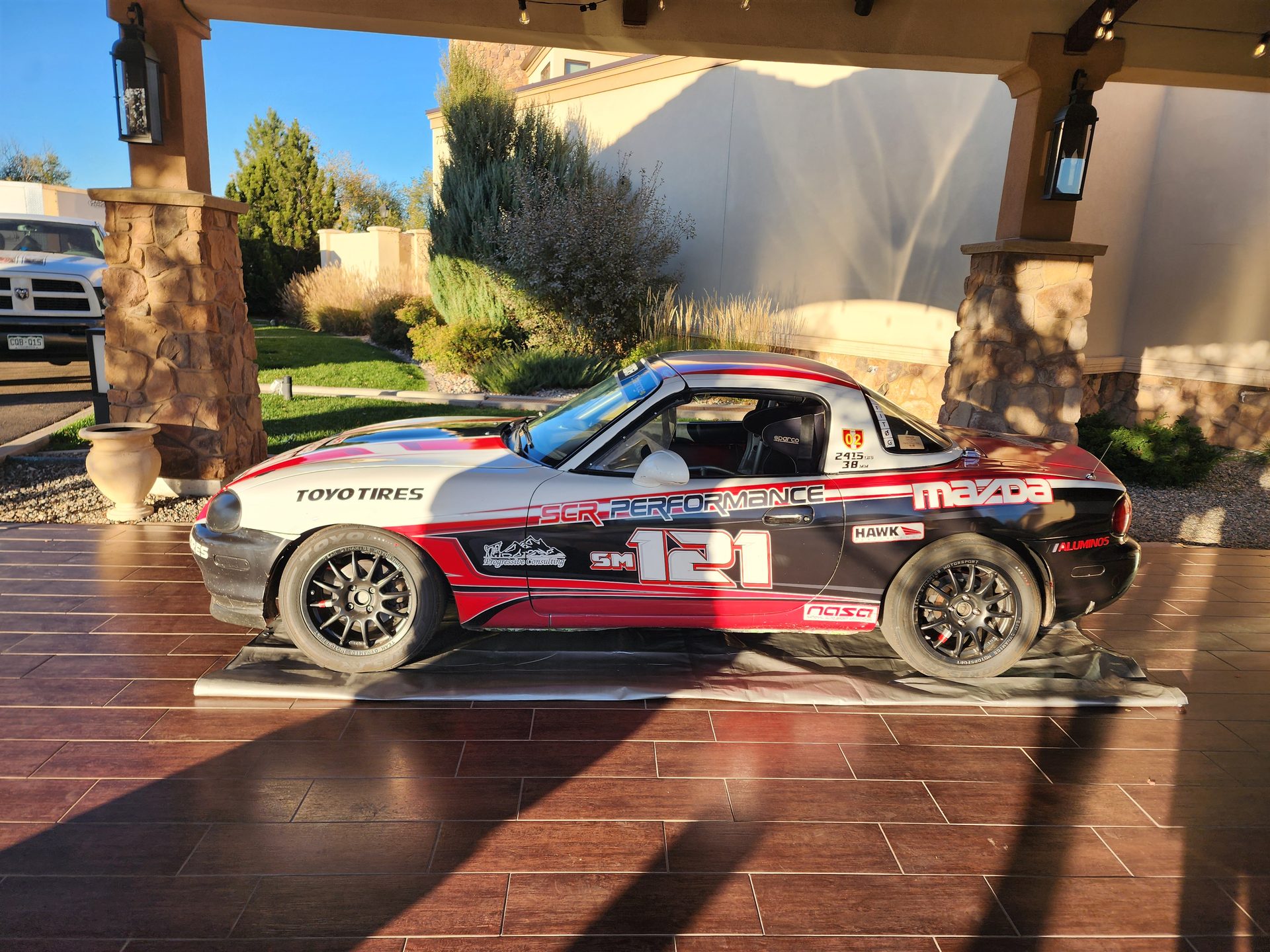 The #121 on display at The Pinery during Spark the Springs, Colorado Springs.
Here's what they actually expect, what the building will and won't let you do, and what the day is worth.
An Appearance Is a Line Item, Not a Field Trip
In real endorsement contracts, showing up is a numbered obligation. Pull up a standard athlete endorsement template — fynk's public version is a good one — and look at the blanks it asks you to fill.
Number of public appearances per calendar year. Maximum duration in hours the athlete can be held to without agreeing to more. Number of photo or video sessions. A line putting reasonable out-of-pocket expenses on the company. And a clause saying appearances get scheduled with the athlete's approval, and can't collide with competition obligations.
Every one of those blanks exists because somebody once fought about it.
So before you answer the email, get four things in writing. Not a contract. An email with dates in it.
- The date and the hours. "Load in Thursday 2pm, floor hours Friday 9 to 4." Not "the show."
- Who pays for what. Fuel, hauling, hotel, meals. Standard practice puts reasonable expenses on the sponsor because the appearance is their asset, not your vacation.
- How many of these you owe them this year. One is a favor. Four is a job. Decide which now, while everyone's happy.
- What "the car" means. Rolling display only? Fired up? Driver in a suit? Sim rig too?
If you've never structured an appearance as a priced, dated deliverable, that's the deliverable menu inside The Funded Season Kit — $197, eleven modules. Appearance days get their own, because they're the most common place a racer works for free without meaning to.
The Building Has Rules, and They're Stricter Than You Think
This is the part that blindsides people. A race car indoors is not a car. It's a fuel source in an assembly occupancy, and fire code treats it that way.
The International Fire Code language on indoor trade shows — here's the Oregon adoption, Appendix N, which is the clearest published version — is specific:
- Fuel tanks may hold no more than one quarter of capacity or 5 gallons, whichever is less (N107.3.2.2).
- Fuel tank openings must be locked and sealed to keep vapors in (N107.3.2.4).
- The fuel system must be inspected for leaks before the car enters the building (N107.3.2.3).
- No fueling or defueling inside. Ever. (N107.3.2.1)
- Batteries get disconnected on gas and diesel vehicles (N107.3.1).
- The car can't block a means of egress (N107.3.3).
Venues layer their own rules on top. Kansas City Convention Center's published operating guidelines repeat the five-gallon-or-quarter-tank limit. They require battery cables disconnected from the ignition system and fuel tanks "locked or effectively sealed."
Then they add the one people forget: ignition keys stay with a responsible person at the display, so the car can be pulled out in an emergency. Need power for a display? Auxiliary source. Not the car's battery.
Read that list again with a race car in mind. A cut-off switch instead of a battery terminal. A fuel cell instead of a stock tank. A cap that was never designed to lock. Your car is the one on the floor that doesn't fit the form.
So do this three weeks out, not three days out:
- Ask the sponsor for the exhibitor services manual and the venue's vehicle display form. There's almost always a form, and it's almost always due early.
- Measure the whole path, not just the booth. Dock height, freight door, aisle width, any turn tight enough to matter with a car that doesn't steer under its own power.
- Ask whether it's push-in only. Most halls won't let you drive on the floor. Plan on four people and a push bar.
- Bring floor protection. Plastic under the car on carpet, and a drip pan under the engine. Nobody has ever been mad about too much plastic.
- Confirm your master cut-off switch satisfies their battery rule, or plan to actually pull a terminal.
None of that is hard. All of it is embarrassing to discover at 6am on load-in day.
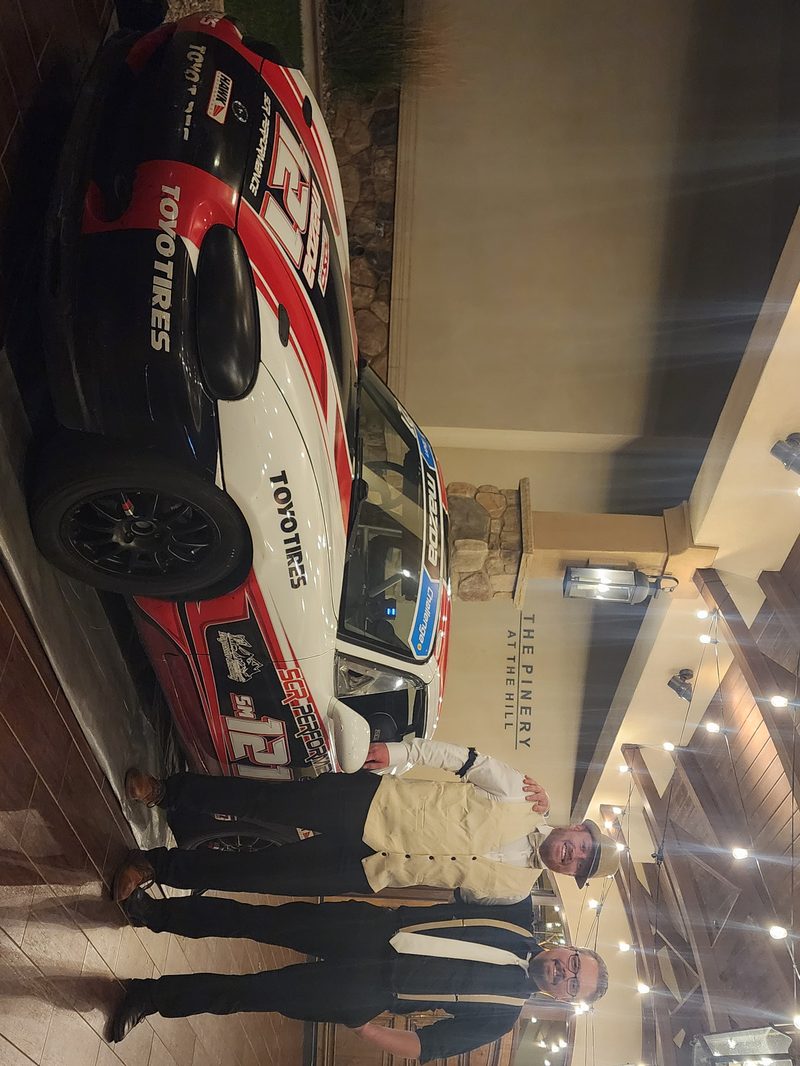 The sim rig at Spark the Springs. The car stops people. The thing they can touch is what keeps them there.
Your Job in the Booth Is Not to Talk About Racing
Here's where racers get it backwards. You're not the exhibit. You're booth staff for a company whose product you probably can't explain yet.
Freeman's July 2026 trends report found attendees would ideally spend 54% of their learning time outside traditional session rooms. At trade shows, that number rises to 64%.
Translation: the floor is the classroom. Your car is the reason a stranger stops walking. What happens in the next ninety seconds belongs to your sponsor.
So show up prepared like staff:
- Learn their three talking points. Not their catalog. The three things they're at the show to say.
- Learn the handoff line. "That's exactly what Marcus handles — let me grab him." You're a conversation starter, not a closer.
- Never quote their pricing. Never promise stock, lead times, or terms. One wrong number from you is a real problem for them.
- Wear their brand, and bring your suit and helmet for photos. The firesuit is what makes their booth photograph well. Use it.
- Point at the car, then point at them. "This is the coolant that's in it — these guys make it." That sentence is the whole product you're delivering.
And shoot content all day. Their booth, their team, their customers in your seat. You'll need it in about forty-eight hours.
The Follow-Up Is Where the Renewal Actually Lives
You'll see a stat everywhere claiming 80% of trade show leads never get followed up. I chased it. Some versions credit CEIR, some credit a 2012 Salesforce post, and none land on a study I can link you to. So I won't lean on it.
What I can point at is smaller and honest: sales trainer Brian Jeffrey handed out "phantom" business cards to exhibitors at a business show and reported 85% never followed up in any form. One person, one show, not a study. But it rhymes with what anyone who's worked a booth has seen.
Which means the bar for your follow-up is low, and clearing it is what gets you invited back:
- Within 48 hours: a one-page recap to your contact. Hours worked, rough count of conversations, three best moments, the photo set.
- Hand over usable photos, properly licensed — and know whose they are before you send them, which is a bigger deal than most racers realize. We covered that in who owns the photo of your race car.
- Ask one question: "What would make this more useful next time?" That question is how a one-off becomes a line in next year's agreement.
The post-event report template in The Funded Season Kit is built for exactly this — because a day you can't document is a day the sponsor's finance team has no reason to fund again.
What the Day Is Actually Worth
An appearance day is inventory. It's your time, your hauler, your fuel, your Saturday, and a physical asset nobody else at that show can produce.
It's also something a decal can never be: a thing the sponsor can point at internally and say this happened, here's what it did. That makes it one of the most valuable items you sell. Which is why it belongs in the written package with a number next to it, not in a friendly text message.
We ranked the whole inventory in every sponsorship asset on your race car, ranked. Appearance days punch way above the hood.
Two things this post doesn't cover. When they come to you at a race weekend, that's a different day with different rules — how to host a sponsor at the track owns that one. And standing the car up at a storefront or community event is its own playbook, covered in brand activation events.
If you're still working on landing the first partner who'd even invite you, start at The First Sponsor System — $67, and it's the prospecting-to-first-yes end of the ladder.
But if you already have a sponsor and an invitation sitting in your inbox, get The Funded Season Kit. The appearance-day module, the deliverable menu with dates attached, and the post-event report are the three pieces that turn "can you bring the car?" into a renewed contract instead of a long weekend you paid for yourself.
Show up early. Bring plastic. Learn their talking points. Send the recap.
Do you believe?
Sources: Oregon Fire Code 2022, Appendix N — Indoor Trade Shows and Exhibitions (UpCodes), Kansas City Convention Center — Building Operating Guidelines, fynk — Endorsement Agreement Template (Professional Athlete / Brand Partnership), USLegal Sports Law — Endorsement and Appearance Contracts, Freeman Trends Report, July 2026 (GlobeNewswire), Salesforce Training — Are Your Salespeople Squandering Tradeshow Leads?. Fire code citations are from the Oregon adoption of the model code — your venue's rules govern, and they are frequently stricter. Contract language is a template, not legal advice. Verified September 2026.