
You spent a grand on a direct-drive wheel. The force feedback is crisp, and you can feel the front tires bite. Then you grab a real steering wheel at speed, and the conversation sounds different.
It isn't worse. It's just not the same language. Here's what your wheel can't tell you, and how to learn the real one.
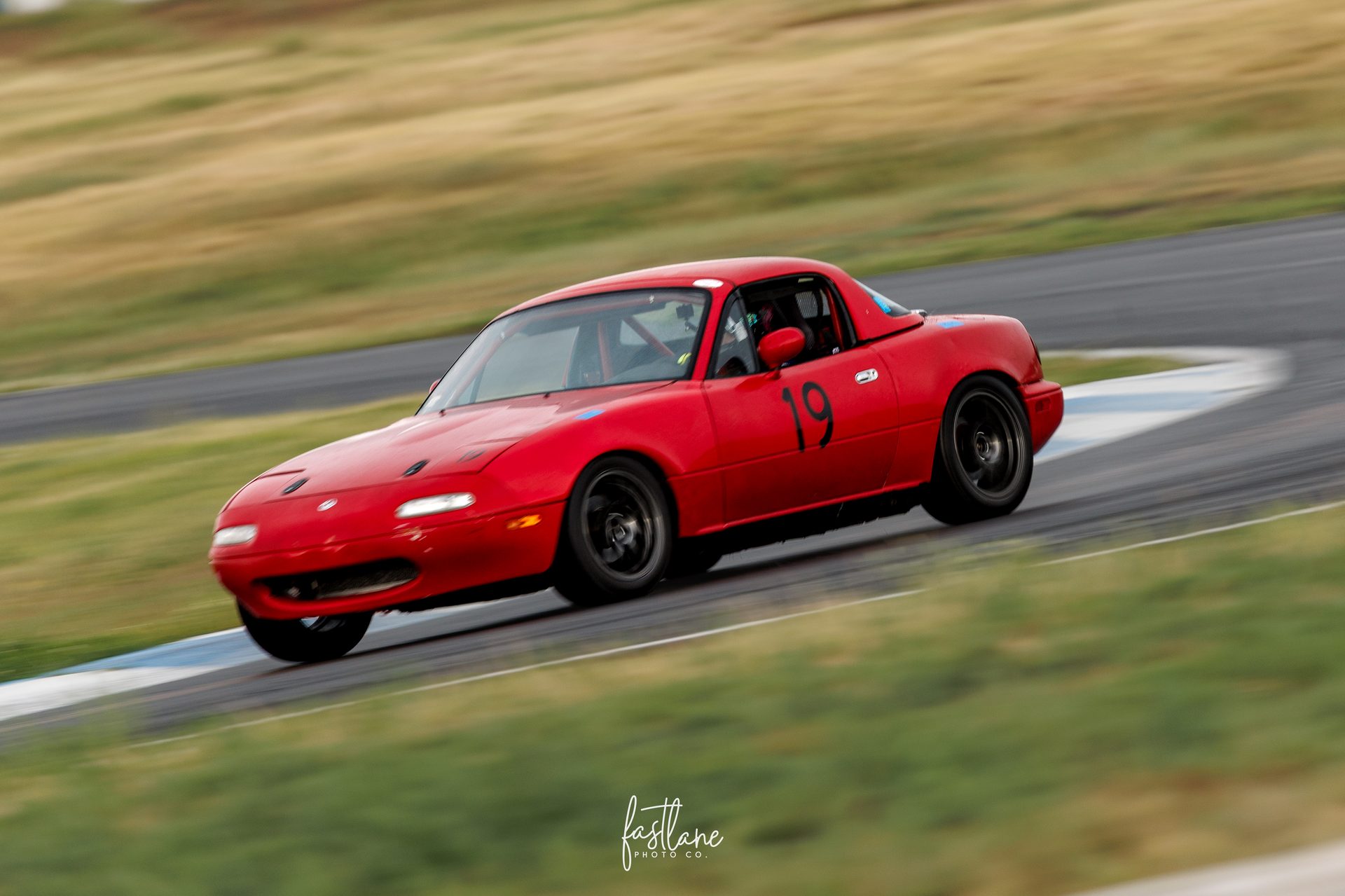 Our #19 Spec Miata using the curbing at High Plains Raceway, NASA weekend, August 2026.
Your wheel shows a model, not the car
A sim wheel plays back forces that a physics engine calculates. Early wheels didn't even do that. Wikipedia's history of sim wheels says the first ones used springs, so resistance only grew with steering angle and ignored what the car was doing.
Modern force feedback is far better. It is tied to the simulated car and tries to recreate the forces coming up through the steering rack.
But it is still a recreation. You can judge how the sim thinks a car behaves. You can't confirm the sim matches your actual car. That's the first thing to hold loosely.
Self-aligning torque is your best cue, in both worlds
When the car turns, the tires push back and try to straighten the wheel. That pull is called self-aligning torque. Takegaki Drive's explainer describes it as the force that returns the steering wheel straight, shaped by things like caster angle.
Sim racers learn to read it well. It's how you catch understeer and oversteer on screen.
The real car does the same thing, and the idea transfers. Speed Secrets says you feel understeer or oversteer "typically in the steering." So your wheel habits are a real asset.
Learn to read the weight of the wheel. That skill goes with you.
What the wheel can't give you: the rest of your body
Here's the gap. In a sim, almost all the information comes through your hands. In a real car, it also comes through your seat, your back and your ears.
Ross Bentley has written about this from the other side. In a Winding Road column, he calls that kinesthetic feel arguably the most important part of driving a real car. He calls its absence the biggest barrier for drivers entering sim racing.
Flip that around. If you live in a sim, you've trained your hands and ears. Your hips and chest are untrained.
In a real car, the rear starts to rotate and you may feel it in your seat first. Pay attention to that. Don't wait for the wheel to tell you.
Don't chase a number: torque isn't realism
Wheelbase ads love Newton-meters. More must mean more real, right?
Not exactly. Fanatec, a wheel maker, publishes its own comparison. It lists typical real-car steering torque from about 2 to 3 Nm in a compact car with electric power steering, up to about 10 to 12 Nm in a low-assist sports car at a standstill. The same page says GT3 cars are typically capped near 6 to 8 Nm.
It also says its top 25 Nm base goes past real-world steering torque. And it concedes that grip, road texture and car behavior matter more than the raw number.
Treat those as one vendor's figures, since real effort varies with power steering, geometry, tires and speed. The point still holds. A stronger wheel doesn't make your sim feel more like a real car. Tuning and accurate physics do.
What to do before your first real laps
You don't need to give up the sim. Just aim it at the right job.
- Turn the strength down. A wheel set so heavy it wears you out hides small details. Aim for clear, not violent.
- Practice reading weight, not just grip. Notice when the wheel goes light or heavy, then name what the car was doing.
- Train your ears. Drive a few sim laps with the wheel feel turned down and listen to the engine and tire noise. Real cars give you a lot of information through sound.
- Expect a slower first session. Slip angle is something you only sense near the limit, as Speed Secrets notes. At street speeds there's almost none to feel. So give yourself laps to find it.
- Get a coach in the seat. Someone beside you or on the radio can tell you what your body is feeling. The move from sim racing to real racing goes faster with a person than with a plan alone.
If you want more on what changes in your body, I covered it in real racing g-forces for sim racers. And for the setup side, see what sim racers get wrong about real car setup.
We built the Race Day Ready Pack for exactly this first weekend. It's free, and it covers what to track so you can compare your sim notes to what the real car did.
The honest bottom line
Your wheel gave you a real skill: reading a steering load. Keep it.
But the real car will add information your hands never got. Your seat, your ears and your hips all join the conversation. Give it a few sessions to learn.
If you're ready to put those hands on a real Spec Miata wheel, with a crew and coaching around you, apply to Kart to Car. We'll talk through the right first step.
Do you believe?
Sources: Wikipedia, Sim racing wheel, Takegaki Drive, What is self-aligning torque, Speed Secrets, What is slip angle, Winding Road, Speed Secrets: Simulated or Real Fun?, Fanatec, How realistic is Fanatec torque. Torque figures are one wheel maker's published comparison, and the Bentley column is about 13 years old. Numbers verified as of November 2026. Anything else here is based on these sources plus my own racing experience.