
Sponsorship
Racing Contingency Programs: 9 That Pay and How to Claim
Jett Johnson10 min read
The short answer
- Contingency pays you in cash, product credit or free parts for running a brand's products, showing its decals and finishing near the front.
- Mazda's 2026 NASA regional points awards pay $2,000 down to $750 for 1st to 5th in road racing classes.
- Deadlines bite: Mazda cuts pay 25% after 45 days, Goodyear's SCCA claims close at 30 days, Hawk's NASA program allows 180.
- 2027 terms aren't posted yet. The 2026 programs went live February to May, so register early in your NASA or SCCA account.
Racing contingency programs pay you for doing what you were going to do anyway: run a brand's parts, show its decals, and finish near the front. The catch: the money only shows up if you register before you race and claim before the deadline.
Here are 9 programs that pay grassroots racers, what each one published for 2026, and the exact steps to get paid.
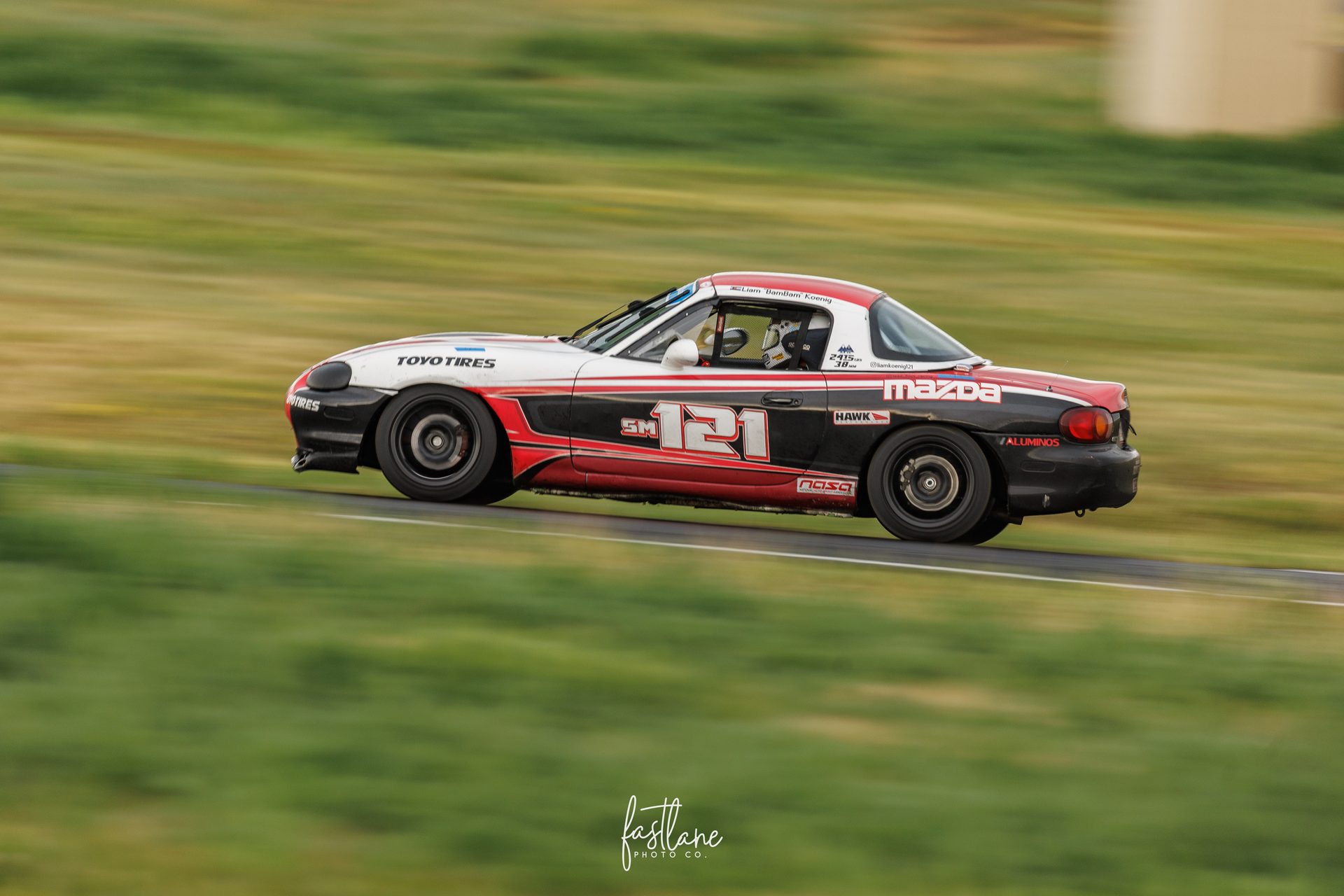 The #121 at High Plains Raceway, August 2026. Photo by Fastlane Photo Co for LeadFoot Racing.
What is a racing contingency program?
A contingency program is a posted deal from a manufacturer. It says: run our product, show our logo, finish in these spots, and we'll pay you. The payment might be cash, a product certificate, or free tires.
It's not a sponsorship you pitch. Nobody reads your deck. You enroll, you race, you claim.
That's why it's the easiest "sponsor" most racers ever land. It's also why it rarely covers a season. We'll get to that.
Which contingency programs pay grassroots racers in 2026?
Every figure below comes from the program's own 2026 page or its sanctioning body's 2026 announcement. Where a program hides its amounts behind a member login, I say so instead of guessing.
| # | Program | Where it pays | What it published for 2026 | Claim window |
|---|---|---|---|---|
| 1 | Mazda Motorsports | NASA, SCCA and more | NASA regional points, road racing: $2,000 / $1,250 / $1,000 / $800 / $750 for 1st to 5th | Full pay within 45 days, then cut |
| 2 | Toyo Tires (Toyo Bucks) | NASA | Amounts on NASA's member page. The 2025 example: $525 for a Spec Miata win with 19+ starters | Redeem within 30 days of your certificate |
| 3 | Hawk Performance | NASA and SCCA | NASA: $200 endurance win, other amounts on the member page. SCCA Runoffs: product certificates | NASA: 180 days |
| 4 | Frozen Rotors | NASA | $100 credit for 1st to 3rd, $75 for 4th and 5th, 5+ starters | Not stated in the announcement |
| 5 | VP Racing | NASA | $75 / $50 / $25 certificates for the podium, 5+ starters | Not stated; awards now expire |
| 6 | Goodyear | SCCA Super Tour and U.S. Majors | 2 tires for 1st, 1 tire for 2nd, in listed classes | 30 days after the event |
| 7 | EBC Brakes | SCCA Runoffs | $250 / $150 / $75 cash, Spec Miata included, 5+ in class | SCCA staff file it |
| 8 | Hoosier Racing Tire | Programs by sanctioning body | Set by sanctioning body on Hoosier's site | Proof of purchase dated within 180 days |
| 9 | NHRA contingency | Drag racing | 100+ manufacturers, $11 million+ posted. Typical: $300 to win, $100 runner-up at national events | NHRA tech verifies, the brand pays you |
A few notes that matter more than the table.
Mazda is the big one for Miata racers. Its 2026 program says awards run from $100 for a 5th place autocross finish up to $250,000 for the MX-5 Cup champion. If you're a young racer, it also pays the Teen Mazda Challenge: $500, $350 and $250 for the top three regionally. We broke that series down in the Teen Mazda Challenge explained.
Read the class list. Goodyear's SCCA program doesn't list Spec Miata. EBC's Runoffs program does. A program that doesn't cover your class pays you nothing, no matter how good the decal looks.
Short-track racers have their own system. Contingency Connection's Racer Rewards program gives member tracks books of manufacturer certificates. The track decides who gets them. Performance Racing Industry reports that tracks like to spread them through the field, not just to winners.
For the wider list of brands that back grassroots racers, start with our 27 companies that sponsor grassroots racers. This post is only about the ones with a posted payout.
How do you claim racing contingency money?
Every program has its own fine print. But the claim steps are almost always the same seven moves.
- Register before you race. SCCA requires you to register each year before competing. Mazda requires you to enroll in its Team Support Program before the event. Register after the race, and that race doesn't count.
- Run the product, and keep the invoice. Hoosier wants a paid invoice dated within 180 days of the event. It also says tires you won through contingency can't be used for a future claim.
- Put the decals exactly where they ask. Hawk's 2026 NASA program wants decals on all four sides of the car. EBC and Goodyear at SCCA want one on each side. Mazda's 2026 rules spell out a 16-inch hood decal and 22-inch rear fender decals.
- Take the photos. Toyo's 2026 NASA registration asks for four photos showing decal placement and one showing Toyo product on the car. Mazda wants a photo of you in your suit with its 5-inch patch.
- Check the field size. Frozen Rotors and VP Racing pay only with 5+ starters. Goodyear needs 3 starters for a 1st place award and 5 for 2nd.
- File the claim the week you get home. Most NASA programs now live inside your DriveNASA profile. You enter your finish, the number of starters and a link to official results. Then you track the award right there.
- Redeem before it expires. A won certificate isn't money yet. Toyo Bucks have to be redeemed with an authorized dealer within 90 days. Hawk's SCCA Runoffs certificates expire February 1, 2027.
Most of this is admin, not racing. That's exactly why people skip it.
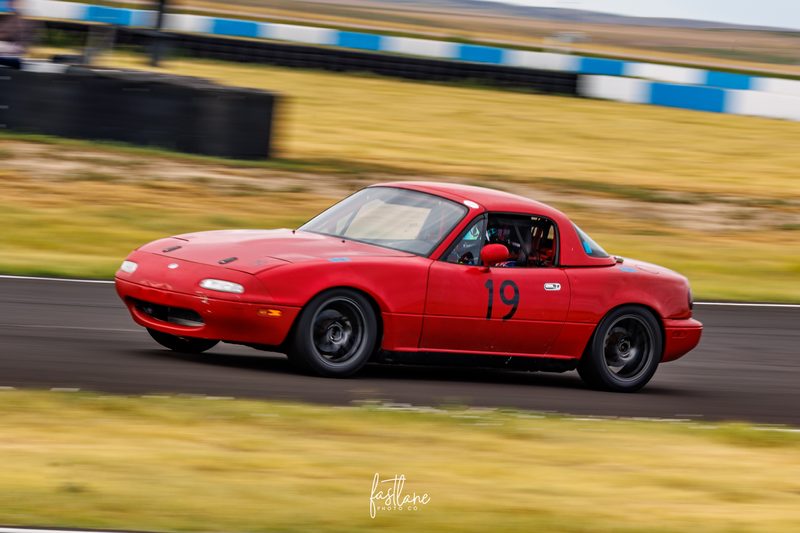 The #19 at the NASA weekend at High Plains Raceway, August 2026. Photo by Fastlane Photo Co for LeadFoot Racing.
What happens if you miss a contingency deadline?
You lose money. Sometimes all of it.
Mazda's 2026 rules are the clearest example. Send your claim, official results, photos and W-9 within 45 days for full pay. After 45 days, Mazda cuts it by 25%. After 90 days, by 50%. After 120 days, it's declined.
Its year-end points award has fine print too. For the full payout in a series with fewer than 14 races, you need at least 7 of the points races. You also need to finish ahead of at least 3 class competitors who ran 4 or more races.
| Program | What the 2026 rules say |
|---|---|
| Mazda | Full pay within 45 days; -25% after 45, -50% after 90, declined after 120 |
| Goodyear (SCCA) | Claims due no later than 30 days after each event |
| Toyo (NASA) | Submit your certificate within 30 days of issue; spend Toyo Bucks within 90 days |
| Hawk (NASA) | Claim period extended to 180 days |
| Hoosier | Proof of purchase dated within 180 days of the event |
If you raced this fall, your clock is already running. Count 45 days from NASA Rocky Mountain's November 8 finale at Pueblo, and you land on December 23. File it before the holidays, not after.
Here's where the paperwork stops being enough. We built The First Sponsor System ($47) for the money contingency can't reach. Its sponsor list notes whether each company typically gives cash, product or contingency. And it includes a sponsor tracker spreadsheet, so your deals and deadlines live in one place, not your inbox.
Is contingency enough to fund a season?
No. It's a floor, not a funding plan.
Look at what contingency actually pays for: tires, pads, fluids, fuel. Those are wear items. The line it never touches is your entry fee. NASA Rocky Mountain's 2026 season finale at Pueblo listed $549 for both days. You pay that whether you finish first or twentieth.
And every payout depends on finishing at the front. Our racing sponsorship vs contingency case study shows a NASA Spec Miata champion who covered his tires through contingency. His biggest line was still entry fees: $4,335 at full price.
So register for everything you qualify for. Then go get the cash. Landing that first cash sponsor is the whole job of The First Sponsor System.
What we actually do at LeadFoot Racing
We race Spec Miatas in NASA Rocky Mountain, and our partners are Les Schwab, OG Racing and Engine Ice. None of those is a contingency check. Each is a partnership: tire service, safety-gear pricing and coolant, earned by pitching the right company and then delivering for them.
That's on purpose. We sell sponsorship cash first and treat product and contingency as the sweetener. A sponsor who pays for one specific line item is worth more than a $75 certificate you can only win on a good day. If that's the ask you want to make, read how to ask a sponsor to buy your tires. It shows how to turn one line of your budget into a small, fast yes.
Contingency still belongs in the plan. It's free money for the work you already do. Just don't let it be the whole plan.
When do 2027 contingency programs come out?
Not yet, as of November 2026. None of these programs has posted 2027 terms.
The 2026 versions landed across the spring. Mazda's 2026 program PDF was last updated February 2. NASA announced Toyo's on March 18, Frozen Rotors on April 29, VP Racing on May 12 and Hawk on May 20. Expect a similar rollout, and check each page again in January.
What you can do now:
- Log into your DriveNASA or SCCA account and find the contingency section.
- Save last season's invoices for tires and pads.
- Measure your car for the decal sizes above.
- Put every 2026 claim you haven't filed on a list and file it this week.
Get paid for the season, not just the podium
Contingency rewards you for results. Sponsors pay you for value. You want both, and only one of them shows up on a posted payout page.
If you want the method for the second one, The First Sponsor System is $47. It's the same set of documents we use to fund our own cars. You get the method, the outreach templates, the sponsor list and the tracker. Not ready to buy? Grab the free 25 sponsorship email templates and send your first pitch this week.
Register for the free money. Then go ask for the real money.
Sources: Mazda Motorsports, 2026 Contingency Awards Program Payouts and Requirements (PDF, updated Feb 2, 2026), Mazda Motorsports, 2026 program page, NASA Speed News, Toyo Tires 2026 program (Mar 18, 2026), NASA Speed News, Toyo 2025 payouts (Feb 26, 2025), NASA Speed News, Hawk 2026 (May 20, 2026), NASA Speed News, Frozen Rotors 2026 (Apr 29, 2026), NASA Speed News, VP Racing 2026 (May 12, 2026), NASA Speed News, DriveNASA claim process (Mar 11, 2026), SCCA, Goodyear Super Tour and U.S. Majors, SCCA, Hawk Runoffs, SCCA, EBC Brakes Runoffs, Hoosier Racing Tire, contingency program, NHRA, 60 years of contingency (Feb 17, 2026), Performance Racing Industry, How to Maximize Contingency Programs. Program terms change, and sponsors reserve the right to change them at any time, so check each page before you race. Verified November 2026.
Do you believe?
About the author
Jett Johnson
Founder of LeadFoot Racing, a Spec Miata race team in Colorado Springs that races in the NASA Rocky Mountain region. Jett holds degrees in mechanical engineering, mathematics and aerospace engineering, has raced since 2022 and has spent years working with sponsors in motorsport. What you read here comes from building the team's race cars, running race weekends and writing real sponsorship proposals.
Meet the team