
Sponsorship
How to Get a Racing Sponsor at 16: The 7-Step Starter Plan
Jett Johnson8 min read
The short answer
- Start with your parent. They sign the deal, so copy them on every sponsor email.
- Make your first ask one real line item, like a ~$262 set of kart tires or a ~$500 race entry. Not a whole season.
- Pitch 20 local businesses you can actually reach. Skip alcohol, vape and gambling brands.
- Deliver like a pro: disclose every sponsored post and send a recap after every race.
You can get a racing sponsor at 16. The plan is simple: bring your parent in first, ask for one specific thing, and pitch businesses that already know your family.
What you can't do is pitch like a 30-year-old with a race team. Your age changes who signs, what you can ask for and where your first yes comes from. Here's the whole plan, in order.
 Every decal on a race car started as one person asking one business for one thing.
Can you get a racing sponsor at 16?
Yes. Nothing in the rules stops a business from backing a teen racer. The real hurdle is trust. A business owner wants to know who is accountable and what they get back.
Speed helps, but it isn't the deal. One karting coach puts it well: winning is the easiest way to find a sponsor, "but it's not the only way." We wrote a whole post on why you don't need to be fast to get sponsored.
Your age can even be the hook. A Newsweek profile of a 15-year-old Spec Racer Ford driver quoted a motorsport marketing CEO saying "building a personal brand is becoming an increasingly important part of a young driver's career development." In that story, the driver's dad runs his accounts. That's the model at your age too: you race and create, a parent backs you up.
Step 1: Who needs to be on your team before you pitch?
Your parent or guardian. Do this before you send a single email.
In most states, someone under 18 can't be held to a contract. So any brand with sense will want an adult on the paperwork. We broke down exactly who signs a minor's racing sponsorship and what that parent takes on. Read it together.
If your parents aren't sold on racing yet, start with how to convince your parents to let you race. A sponsor pitch from a family that isn't on the same page falls apart fast.
Then agree on three things at the kitchen table:
- Which email address the sponsor talks to (one thread, parent copied)
- Whose account the money lands in
- What you will and won't promote
Step 2: What should a 16-year-old ask a sponsor for?
One real line item. Not "help with my season."
A first-time business sponsor says yes to a number they can picture. One karting coach's advice: "Be realistic. Ask for something of comparable value." Here's what real line items cost:
| What you ask for | Real cost | Source |
|---|---|---|
| One set of kart tires | ~$262 | Word Racing karting cost guide (2026) |
| One kart race entry | $70-$120 per race | Word Racing |
| Youth Snell CMR2016 kart helmet | ~$237-$250 | fastracer.com listing |
| One NASA Rocky Mountain race weekend entry | ~$500 ($549 for both days at the Nov 2026 Pueblo finale) | NASA event page |
| One set of Spec Miata race tires | ~$1,200-$1,250 | spec-miata.com cost list |
Pick one row. "Would you cover my tires for the May race?" is a yes-or-no question a shop owner can answer on the spot. Cash tied to a line item is best. A product deal is a fine first step, and product vs cash sponsorship explains the trade-offs.
Step 3: Is your social media ready for a sponsor to look at?
Assume they'll look before they reply. Here's what they'll find, and what a sponsor finds when they Google you goes deeper.
There's a teen wrinkle here. Meta puts new Instagram users under 18 into a Teen Account that's private by default. Meta's rule that you need a parent's permission to go public is written for teens under 16. At 16 you're past that line. But a sponsor can't see a private account, so you'll want a public racing account your parent can see too.
Keep it clean and about racing: car prep, track days, school-week grind, the real stuff. Why Instagram matters more than lap times covers what brands actually check.
Step 4: What goes on a teen racer's one-page resume?
One page a business owner can read in a minute:
- Your name, age, town and what you race
- Your schedule: where and how many events
- Your audience: followers, views, where they live
- Three things the sponsor gets (logo spot, posts, a race-day visit)
- The ask from Step 2, with a dollar figure
- Your parent's name and email
Don't make it a sob story about how expensive racing is. A sponsor buys marketing, not a dream.
We put a fill-in Driver Resume & Sizzle Package inside The First Sponsor System, along with a chapter written for families funding a young driver. It's the same set of documents we use to fund our own Spec Miatas.
Step 5: Which businesses will sponsor a teenager?
The ones that already know you. Make a list of 20:
- Places your family already spends money: the tire shop, the gym, the dentist
- Your parents' employers, and their friends' businesses
- Businesses whose banners already hang at your school's games
- Shops at or near your kart track
Skip national brands for now. A local owner gets almost no racing pitches. A national marketing team gets stacks of them. We explain why in local business vs big brand for your first sponsor.
Also skip whole categories. We don't promote alcohol, tobacco, vape, cannabis, gambling or adult brands. At 16 those deals put your whole family in an awkward spot.
Step 6: How do you actually pitch at 16?
In person if you can, by email if you can't. Parent copied either way.
Walk in, shake a hand, leave your one-pager, follow up by email that week. The email itself should be short: who you are, why you picked them, the one ask. Our 30-day first-sponsor plan lays out the list, the sends and the follow-ups day by day. Run it as written.
Lead with your age. A teenager who shows up organized with a parent, a page and a specific ask is rare. That's memorable.
Want the whole kit instead of building it from scratch? The First Sponsor System is $47: the 30-day action plan, outreach templates, sponsor tracker, contract basics and the young-driver chapter, all in one place.
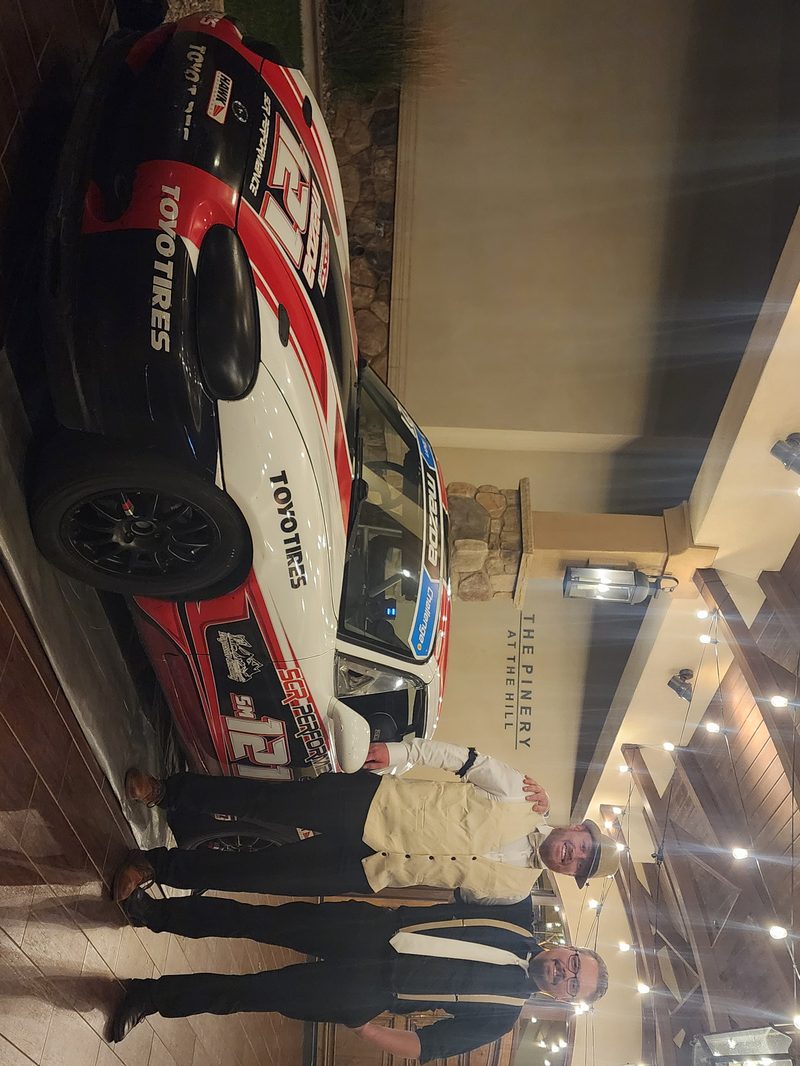 A sim rig at a community event. Showing up where people are beats a cold email every time.
Step 7: What do you owe a sponsor after they say yes?
Everything you promised, on time. This is where teen racers win renewals.
Disclose every sponsored post. The FTC says to disclose when a brand gives you money or "free or discounted products." Put it in the post itself, since disclosures "are likely to be missed" if they only live in your bio. "Ad" or "sponsored" works. "Spon" or "collab" doesn't.
Announce it well. Here's how to announce your first racing sponsor.
Send a recap after every race. Photos, results, what happened. How to write a race recap for sponsors has the format. As the same coach put it: "Under-promise and over-deliver."
What we actually do
Every partner on our cars today is a product or service deal. Les Schwab handles our tire mounting, balancing and disposal. OG Racing is our safety gear dealer. Engine Ice gives us ICE Water coolant at a discount.
None of those started as "fund our season." Each one is a specific thing a business already sells, tied to a car they can see. That's the same shape as Step 2. It works for a race team, and it works for a 16-year-old with a kart.
Ready to start?
Start this week: sit down with your parent, pick one line item and write your list of 20. If you want every template, tracker and the young-driver chapter in one place, The First Sponsor System is $47.
Already have a pitch drafted and want a second set of eyes? The Funded Season Strategy Session is $497: a written teardown of your pitch, a 60-minute call and a 1-page plan. Do it with your parent on the call.
Sources: Meta Family Center, Instagram Teen Accounts, Meta Newsroom, Introducing Instagram Teen Accounts (Sept 2024), ABC13, Instagram Teen Accounts and parental controls (Sept 2024), FTC, Disclosures 101 for Social Media Influencers, Blayze, Five Tips for Finding Sponsors (Nov 2022), Newsweek, teen racing driver building a personal brand (2026), Word Racing, how much does it cost to race karts, NASA Rocky Mountain event listing, spec-miata.com costs. Costs verified against our racing cost reference as of November 2026. This is general guidance from a race team, not legal advice. Contract rules vary by state.
Do you believe?
About the author
Jett Johnson
Founder of LeadFoot Racing, a Spec Miata race team in Colorado Springs that races in the NASA Rocky Mountain region. Jett holds degrees in mechanical engineering, mathematics and aerospace engineering, has raced since 2022 and has spent years working with sponsors in motorsport. What you read here comes from building the team's race cars, running race weekends and writing real sponsorship proposals.
Meet the team