
Ambient at Pueblo in July averages 92 degrees. The cockpit is hotter than that. And neither number is the one that matters.
The temperature that decides whether you're sharp on lap 14 is the one inside your suit, against your skin. That's a different number, and almost nobody measures it.
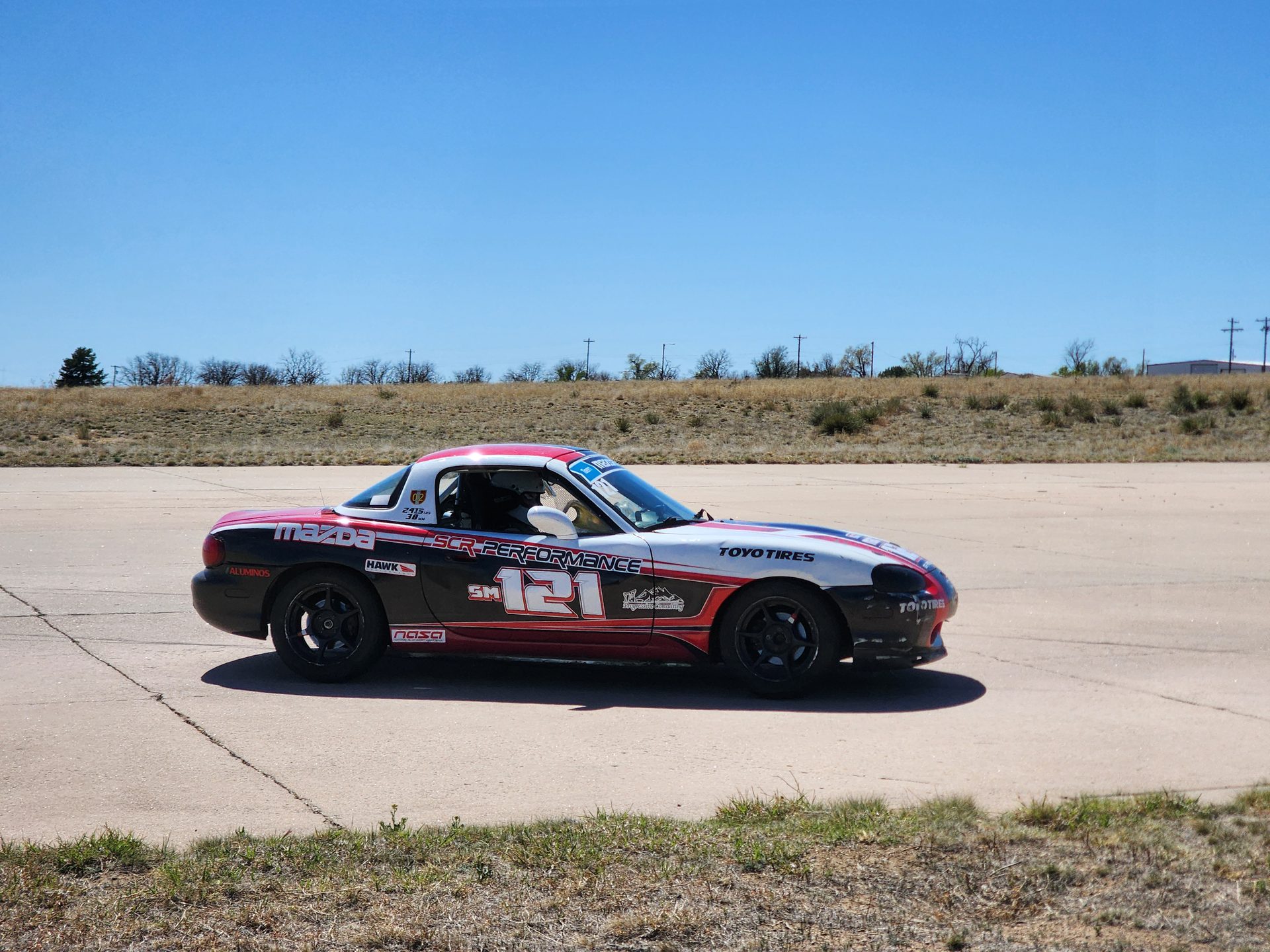
The Actual Numbers
Here's what the research and the industry report, from our end of the sport up to the top of it.
| Environment | Measured temperature |
|---|---|
| Sports car cockpit, hot race | Above 104°F (40°C) |
| NASCAR Cup cockpit | Around 140°F |
| F1 cockpit air, 2025 season | 97°F to 151°F (36–66°C) |
A stripped Spec Miata with the windows out and a fresh-air duct is nowhere near an F1 car. But you're also not sitting in air conditioning. Add a hot exhaust under the floor, a transmission tunnel next to your leg, sun through the windshield, and 25 minutes of work, and a 90-degree day gets ugly fast.
Now the part that surprised me. A 2021 study in Medicine & Science in Sports & Exercise strapped four drivers with core-temperature monitors through a six-hour race in 93-degree ambient heat. Cockpit temperature did not track with the drivers' actual thermal strain. In fact, cockpit temperature went down during stints while every measure of driver strain went up.
The reason is your suit. Nomex, plus underwear, plus gloves, plus boots, plus a helmet, creates a sealed little climate around you. The air around the car and the air around your skin stop being the same thing.
The gauge on the dash is not telling you how cooked the driver is.
That's why the study's conclusion was blunt: if you want to know a driver's heat load, measure the driver.
What Heat Actually Does to Your Driving
This is the part worth caring about, because it shows up in lap times before it shows up as a medical problem.
In closed-cockpit racing, core temperature climbs roughly 1.7 to 2.5°C per hour, with sweat rates near a liter an hour. Sports-science work summarized by the Gatorade Sports Science Institute puts the damage threshold low: a core rise of just 0.8°C is enough to hurt hand-eye coordination and decision making. Push past 38.5 to 39°C and you get measurable drops in attention, working memory, and executive function.
Heat also costs you G tolerance. One classic study found heat stress cut it by about 0.3 G.
Then there's fluid. Lose about 2 percent of your body weight in sweat and attention and short-term memory start sliding. Reaction time holds up a bit longer, but it goes too. For a 160-pound driver, 2 percent is roughly three pounds of water. You can do that in a long, hot double-stint without feeling especially bad about it.
Here's the honest counterweight. A study of stock car drivers in real competition found post-race body weight loss of only about 0.77 percent, with a sweat rate near 0.63 L/hr. Not everybody is on the edge. A single 20-minute club sprint race in reasonable weather is not a survival event. The trouble comes from double race days, long practice sessions, endurance formats, and stacking three of those on a 95-degree weekend without drinking anything.
The Free Stuff Works, and Most People Skip It
Before you spend a dollar, do the things that cost nothing.
Hydrate the day before, not in grid. You cannot fix a fluid deficit ten minutes before the green. Start the weekend already topped off.
Drink cold, not cool. This one has real numbers behind it. Cold water around 41°F held core temperature rise to 1.17°C versus 1.69°C with ambient-temperature fluid in a simulated racing protocol. Ice slurry does even better. Same effort, half a degree cheaper — and half a degree is the difference between sharp and foggy.
Pre-cool. The protocol elite teams use is cold-water immersion at 50–59°F for 15 to 20 minutes, about an hour before the start, then an ice vest until they climb in. You don't have a cold plunge in your paddock spot. You do have a cooler and a towel. Cold towel on the neck and forearms in grid is the poor man's version, and it beats nothing.
Stay out of the suit and out of the sun. Suit tied at the waist, shade over your chair, and you start the session from a lower baseline. This is the single biggest free win at a hot track day.
Get fit in the offseason. A better-conditioned driver runs a lower heart rate at the same pace and handles heat better. Our at-home fitness routine for racers covers what actually transfers.
Cool Shirts and Blowers: What You Get for the Money
A cool shirt is a garment with roughly 50 feet of medical-grade tubing stitched into it, fed by a small pump inside an ice-water cooler bolted in the car. It covers a big chunk of your torso and pulls heat out continuously.
Pricing, straight from NASA's own gear store: the CoolShirt Club 19-quart cooler is $350 — cooler only. Hoses and the shirt are separate. Complete systems commonly land around $500 to $700. Cheaper kits exist, and plenty of grassroots racers build their own out of a hard cooler and a marine pump for well under that.
One honest caveat before you buy. A 2025 study tested six cooling setups on 14 fit subjects in full FIA gear, and the winner was a suit blower feeding cold air into the driving suit, not the cool shirt. Blowers pushing ambient air, and the cool shirt, came in behind it. That was a lab protocol on a bike, not a driver in a car, so weigh it accordingly. But it says something people in the paddock already suspect: moving cold air over sweaty skin, where evaporation can work, is powerful.
For most club racers running 20-to-30-minute sprints, my order of operations is simple. Fix your hydration, get a helmet blower or a proper fresh-air duct, and only then spend on a cool shirt. If you're running enduros, flip that. A cool shirt is one of the best returns in the car.
The Colorado Wrinkle
Both of our home tracks sit near 5,000 feet in high desert, and that cuts two ways.
The gift is dry air. Evaporative cooling actually works here. On a 92-degree day in Pueblo, sweat leaves your skin instead of soaking your suit, so airflow does more for you than it would in Georgia at the same temperature.
The tax is that the same dryness hides how much water you're losing. You never feel drenched, so you never feel like you need to drink. Add the faster breathing that comes with thin air and you can run a fluid deficit for a whole session without a single obvious signal. Then the second race of the day arrives and you're a half-second off with no idea why.
That's the Colorado version of heat management: you probably need less cooling hardware than a Southeast racer, and more discipline about drinking. If you're new to running out here, our guide to Colorado's tracks for new drivers covers the rest of what altitude changes.
When to Get Out of the Car
Know the line, because pride has ended more weekends than heat has.
Stop and tell someone if you get a headache, feel nauseous, get dizzy or confused, get chills or goosebumps in a hot car, or notice you've stopped sweating. Confusion and stopped sweating are the serious ones. Every club event has a medical crew at the track and they would genuinely rather see you early than late.
There's no trophy for finishing a practice session while cooked. The lap times are already gone by then anyway.
Heat is one of the few things in this sport where the cheap fixes are also the best ones. Drink cold water, get out of the suit between sessions, sit in the shade, and treat a hot weekend like the physical event it actually is.
If you'd rather learn all this from inside a car that's already prepped, ducted, and set up for the day, that's what our arrive-and-drive program is built for.
Do you believe?
Sources: Cockpit Temperature as an Indicator of Thermal Strain in Sports Car Competition (Medicine & Science in Sports & Exercise, 2021), Gatorade Sports Science Institute — Cooling Strategies for Formula 1 Drivers, Evaluation of Different Body Cooling Strategies for Race Car Drivers (PMC, 2025), Cold water ingestion during simulated motor racing in a hot environment (PMC), Physiological strain of stock car drivers during competitive racing (ScienceDirect), ESPN — How NASCAR drivers keep their cool in 140-degree cockpits, NASA Racing Gear Store — CoolShirt Club 19qt Cooler, National Weather Service Pueblo — Average Summer Temperatures. Temperatures, pricing, and physiological figures verified against these published sources as of September 2026. Every driver's heat tolerance is different — treat these as ranges, not as your number.