
Case Studies
First Race Season on a Day-Job Budget: Real Costs
Jett Johnson9 min read
The short answer
- Sam is an illustrative example. Every cost and rule in Sam's story comes from a named source.
- Buying in costs about $11,600 at the very bottom, before a tow rig or a single race weekend (our math).
- Three floor-level weekends run $3,000–$4,500; six realistic weekends run $12,000–$21,000 (our math).
- One champion's 2023 season came in under $7,000, but only after years in the sport.
This is an illustrative example. Sam is not a real person. Every cost, rule and fact in Sam's story comes from a named source, numbered [D1]–[D5] and listed at the bottom of the page. Two real racers appear too: Jim Tramontano, from his own published season costs, and Sabré Cook, from a 2021 Jalopnik interview.
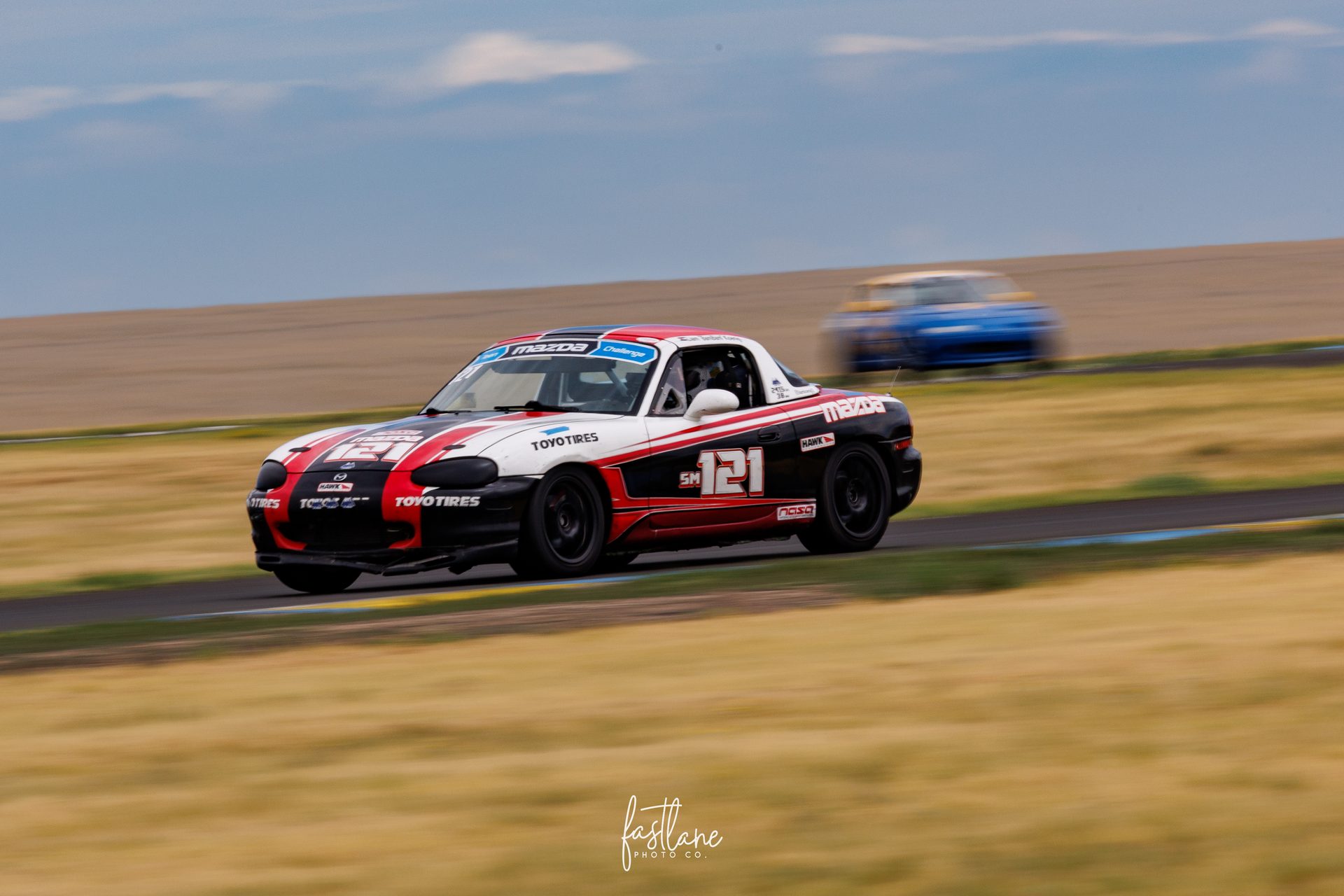 LeadFoot Racing's own photo. The people in this case study are not pictured.
The situation
Sam works full time in Colorado Springs. Sam has done a few autocrosses (timed solo runs around a cone course), watches every in-car video going, and wants to go real wheel-to-wheel racing in a Spec Miata.
Online, Sam keeps hearing the same thing. Jim Tramontano, who won the 2023 NASA NorthEast Spec Miata championship, sums up what people get told: you need "a $40k car and $5k budget per weekend." [D2]
Sam's question is simple: what does a first season actually cost, and how do people with normal jobs pay for it?
The challenge
Racing costs come in two very different piles, and most budgets fail because they mix them up.
- The one-time buy-in: a car, safety gear, a license, a transponder (the timing box that scores your laps), and something to tow with.
- The repeat bill: what every race weekend costs, over and over.
And there's a third thing nobody budgets for: labor. Tramontano puts shop labor at well over $100 an hour, and says one weekend of paid mechanical work could smash his whole season budget. [D2]
The path: building Sam's budget
Step 1: seat time before buying anything
Before spending thousands, Sam gets real laps for less. In Colorado, an SCCA Rocky Mountain Solo autocross costs $60, and winter open lapping (non-competitive track time) costs $140 at Pueblo Motorsports Park or $159–$179 at High Plains Raceway. [D4] That tells Sam whether the passion survives a cold morning in a paddock.
Step 2: the one-time buy-in
| Item | Cost | Source |
|---|---|---|
| Used, ready-to-run Spec Miata | $10,000–$45,000 | [D1] |
| Safety gear: helmet, head-and-neck restraint, suit, gloves, shoes | about $1,100 (cheapest combination) to $4,700 (premium) | [D4] |
| Club license paperwork | under about $300 | [D4] |
| Transponder | about $210 to buy (with a year's subscription), or $80 a weekend to rent | [D4] |
| Tow vehicle and trailer | not priced here. Tramontano lists both among the purchases a new racer needs. | [D2] |
Sam's buy-in floor: about $11,600 before any tow rig ($10,000 car + $1,100 gear + $300 paperwork + $210 transponder).
Step 3: the repeat bill
spec-miata.com lists what goes into a race weekend: $1,250 for tires, $500 entry, $300 for a test day, $250 for fuel and fluids, and $350 for brake pads. [D1] That's $2,650 before transport, hotels, food, coaching, repairs or crash damage, which the same page lists too, without a price. [D1]
LFR's own cost research lands in the same place:
- A realistic do-it-yourself weekend with fresh or nearly fresh tires runs about $2,000–$3,500. [D4]
- A rock-bottom weekend runs about $1,000–$1,500, but only on old tires, doing all your own work, with no crash and a tow vehicle you already own. That's the floor, not a normal weekend. [D4]
- NASA Rocky Mountain weekend entries were listed at $399 early, $449 late and $499 at the track. [D4]
Step 4: how real racers close the gap
Tramontano, whose day job is teaching high school art, published a line-by-line cost breakdown of his championship season (some figures estimated and rounded up, he notes). [D2] His moves are the ones that close the gap on a normal income:
- He does his own work. On a budget, he writes, "you must do your own maintenance and repairs." [D2]
- He camps. Sleeping at the track instead of a hotel saves him roughly $300–$600 every three-night race weekend. [D2]
- He works for the club. His entry fees were $4,335 at full price for six weekends, including Friday practice days, but he pays less because of the work he does for the club. [D2]
- He earns his tires and pads. Contingency (prize money and free parts for finishing well) paid for his tires: his 2023 tire bill was $0. With his brake-pad maker's credits, he typically pays only shipping for pads. [D2] But that only works if you finish near the front, and contingency has strings. Mazda's 2026 program, for example, requires Team Support Program membership, its decals and a suit patch. Its full NASA regional championship award also needs at least 7 points races (races that count toward the season championship) and finishing ahead of at least 3 class rivals. [D3]
Then there's the money from outside: a cash sponsor. Sabré Cook, a pro racer who grew up in Colorado, has said a sponsor deal can take anywhere from a month to a year to close. [D5] So Sam starts those conversations long before the money is needed.
The numbers
| Item | Figure | Source |
|---|---|---|
| The myth people repeat online | "$40k car and $5k budget per weekend" | [D2] |
| Used ready-to-run Spec Miata | $10,000–$45,000 | [D1] |
| Sam's buy-in floor (car, gear, paperwork, transponder; no tow rig) | about $11,600 | our math from [D1][D4] |
| spec-miata.com weekend line items (tires, entry, test day, fuel, pads) | $2,650, before travel and damage | [D1] |
| Realistic DIY weekend / rock-bottom floor | $2,000–$3,500 / $1,000–$1,500 | [D4] |
| A short first season: 3 weekends at the floor | $3,000–$4,500 | our math from [D4] |
| A full first season: 6 weekends at the realistic rate | $12,000–$21,000 | our math from [D4] |
| Tramontano's 2023 championship season, his own "sticker price" | $6,660 ($4,335 entries at full price, which he didn't fully pay, plus $2,325 everything else after contingency) | [D2] |
| His estimate ("may be doable") for a full competitive season doing your own work, with no big problems | about $10,000 | [D2] |
The outcome: what the math says
Sam isn't real, so there's no race result to report. What we can report is what the numbers say.
- The buy-in comes first. About $11,600 at the very bottom, before a tow rig and before a single race weekend. [our math from D1, D4]
- A short first season at the floor is $3,000–$4,500. That's three rock-bottom weekends, and only if Sam runs old tires, does all the work, tows with what Sam already owns and doesn't crash. [our math from D4]
- A full competitive season is a bigger number. Six realistic weekends runs $12,000–$21,000. [our math from D4]
- Experience changes the math. Tramontano's under-$7,000 season came after years of racing, with contingency earned by finishing near the front. He says himself that his budget is what it costs after several years in the sport, and that breaking in requires a significant list of purchases first. [D2]
What this case doesn't say
- These are ranges, not a quote. Tires, travel, your car's condition and one bad crash can move every line. LFR's Colorado prices were verified Aug–Oct 2026; Tramontano's figures are from his 2023 season. Check them before you spend.
- We haven't priced the tow rig. Tramontano lists a tow vehicle and trailer among the purchases a new racer needs. [D2] If you don't own them, budget for them separately.
- This isn't the only way in. This study covers buying and running your own car.
Lessons
- Budget the buy-in and the weekend separately. The car is the big check. The weekend is the bill that keeps coming. [D1][D4]
- Labor is where budgets die. Learn to do your own maintenance, or make a friend who can teach you. [D2]
- Plan year one without contingency. It pays for results, and Mazda's full points-championship awards need at least 7 points races and beating 3 rivals. [D3] Treat it as a bonus.
- Get seat time before you buy. A $60 autocross or a $140 winter lapping day tells you a lot before you spend $10,000. [D4]
- Start the sponsor conversation now. Deals can take a year. [D5] Next season's money gets found this season.
How LeadFoot Racing helps
We're a grassroots team out of Colorado Springs, and most of the racers we talk to have day jobs. We'd rather you go in with honest numbers than quit after one expensive surprise.
If you've been putting in sim laps while you save up, start with our free guide From Sim to Seat, in our Racer Toolbox. It covers what your sim laps buy you, what they don't, and how to plan your first real session.
The myth says you need $40,000 and a crew. The ledger says you need a plan.
Do you believe?
Sources
All web sources accessed 2026-11-14.
- [D1] Spec Miata (official series site), "Spec Miata Costs". https://www.spec-miata.com/costs
- [D2] No Money Motorsports (Jim Tramontano), "How much does a season of racing Spec Miata cost? It can be done for less than you've heard", 2024-06-25. https://nomoneymotorsports.com/2024/06/25/how-much-does-a-season-of-racing-spec-miata-cost-it-can-be-done-for-less-than-youve-heard/
- [D3] Mazda Motorsports, "2026 Contingency Awards Program Payouts and Requirements" (PDF, last updated 2026-02-02). https://www.mazdamotorsports.com/wp-content/uploads/2026/02/2026-Mazda-Contingency-Last-Updated-Feb-2-2026.pdf
- [D4] LFR's verified cost file, from: SCCA Rocky Mountain Solo and NASA Rocky Mountain listings on MotorsportReg; highplainsraceway.com; racepmp.motorsportreg.com; SCCA and NASA licensing and membership pages; Zamp, Bell, OG Racing (an LFR partner), Allstar and Speedway Motors gear listings; pegasusautoracing.com (transponders). Verified Aug–Oct 2026; re-check before publishing.
- [D5] Jalopnik, "American Racer Sabré Cook On The W Series And What It Takes To Find Sponsorship", 2021-10-08. https://jalopnik.com/american-racer-sabre-cook-on-the-w-series-and-what-it-t-1847813243
About the author
Jett Johnson
Founder of LeadFoot Racing, a Spec Miata race team in Colorado Springs that races in the NASA Rocky Mountain region. Jett holds degrees in mechanical engineering, mathematics and aerospace engineering, has raced since 2022 and has spent years working with sponsors in motorsport. What you read here comes from building the team's race cars, running race weekends and writing real sponsorship proposals.
Meet the team